 SafeBOT

Boat Cover With a Tower: Fold, Pad & Check the Fit
Learn when to fold or remove a wakeboard tower, how to measure the stored profile, protect contact points, prevent pooling, and check the setup before storage or towing.

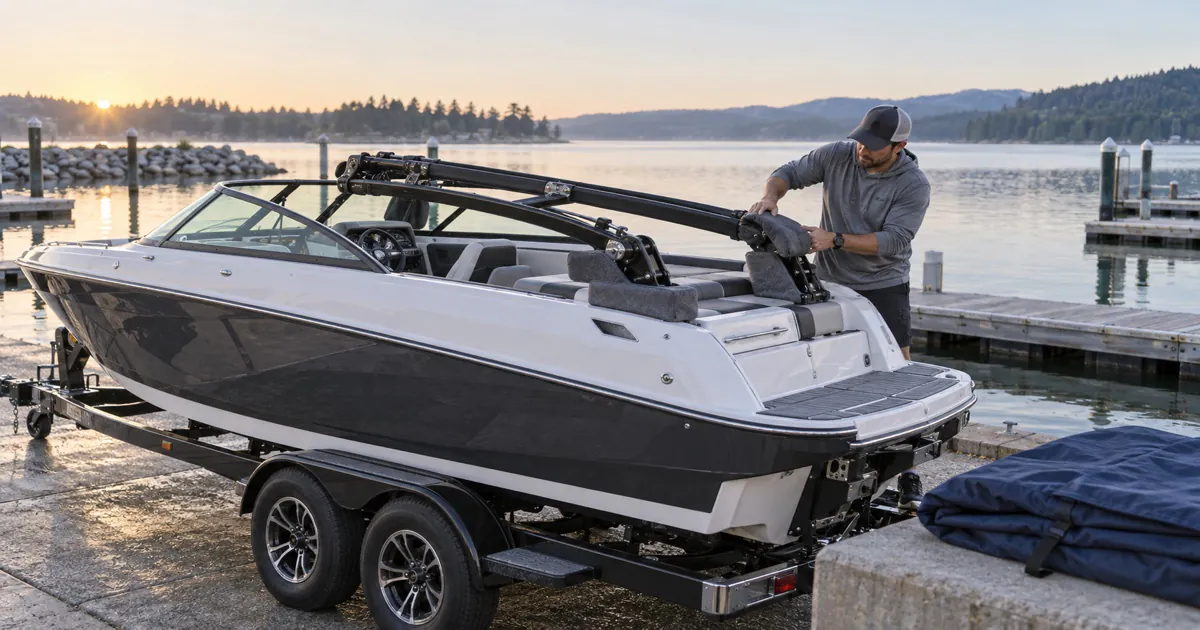
A wakeboard or ski tower changes the cover problem before the fabric ever touches the boat. Tower legs can sit outside the windshield line, board racks may project beyond the gunwales, and a folded tower can create a hard ridge across the cockpit. Pulling a general-purpose cover over that geometry may leave the hem too high, create deep rain pockets, or grind fabric against hinges and racks. A boat cover with tower compatibility has to match the tower’s approved stored position and the boat’s real covered profile.
Quick answer: can you use a boat cover with a tower?
Sometimes. If the tower folds or removes according to its manufacturer instructions and the stored assembly stays inside the cover’s intended profile, a compatible cover may work after careful measuring and padding. A fixed tower, wide board racks, speakers, or tower legs outside the cover line often require a tower-cut or custom cover. Do not force a larger generic cover over a tower and assume extra fabric solves the fit.
Start with the tower manual, not the cover
Towers do not share one folding or trailering rule. Some lower forward, some lower aft, some use removable pins, and some must stay raised for towing because the down position does not lock. The boat or tower manual decides the safe position. The cover must adapt to that position, not pull the tower into a more convenient angle.
MasterCraft’s published owner manuals show why model-specific instructions matter: one tower procedure calls for rotating racks inward and supporting the header while lowering it, while another manual warns that a particular tower should not be towed in the down position. Those examples are not universal instructions for other boats. They are a reminder to identify your exact tower before covering or towing.
Fold the tower only into its approved resting position
Clear boards and loose accessories first. Swivel or remove racks only if the manual permits it, then use the specified release points and supports. A heavy tower can drop quickly or load upholstery in the wrong place. Use the factory rests or padded supports supplied for the boat. Do not let the tower lie directly on seat vinyl, windshield frames, or loose gear.
Remove accessories that widen the profile
Board racks, mirrors, speakers, lights, tow points, and quick-release knobs can become the widest or highest part of the covered setup. Remove only the accessories designed for routine removal. Label hardware and protect electrical connectors from moisture. If a rack stays installed, include its full width and every exposed edge in the fit check.
Use a tower-cut cover when the structure stays upright
A standard cover should not be stretched over an upright tower. Covers built for towers use shaped openings, collars, boots, or reinforced seams around the legs. Those details control water and reduce tearing at the cutouts. If your tower is fixed, unusually wide, or fitted with permanent speakers and racks, a model-specific or custom solution is usually more realistic than an oversized universal cover.
Measure the boat in the exact covered configuration
Measure after the tower is folded, supported, and secured exactly as it will be under the cover. Put the windshield, removable seats, racks, and motor in their storage positions. A measurement taken with the tower half lowered describes a setup you should not use.
- Measure the centerline length from the bow to the stern point the cover must reach.
- Measure the maximum beam at the boat’s widest point.
- Record the highest point of the secured tower and where that point sits along the cockpit.
- Measure the outside width of folded legs, racks, speakers, and hinges.
- Trace the intended hem line and note any tower base that sits outside it.
- Compare the complete shape with the cover maker’s boat-style and size guidance.
The Safeboatz measurement guide explains centerline length, beam, and clearance checks. If the boat also carries a bimini, use the bimini cover guide to evaluate the canvas and frame separately. Length alone cannot tell you whether a tower assembly will fit under a cover.
Protect every hard contact point
Folded towers concentrate weight and hardware in the cockpit. Hinge bolts, rack forks, speaker clamps, cable guides, release knobs, and tow points may all sit beneath a tensioned fabric span. Even a rounded fitting can wear through a cover when wind or road vibration moves the fabric across it for hours.
Use smooth, nonabrasive padding that cannot absorb much water or slide away. Cover the fitting, not an entire section of the cockpit with a loose blanket. Secure padding without placing a hard buckle against the cover. Check the upholstery and gelcoat below the tower too; the structure can rub the boat even when the cover looks undamaged.
Remove the cover after the first windy night or short local tow. Look for polished fabric, gray dust, shiny gelcoat, compressed padding, or a new crease. The boat cover chafing guide provides a closer inspection sequence for contact points and movement.
Build drainage around the tower, not on top of it
A folded tower may form a high ridge, but that does not make it an approved cover support. Cover tension and pooled rain can load hinges, supports, upholstery, and tower mounts in directions they were not designed to carry. It can also create two low basins beside the tower.
Use the cover’s intended support system to create a clean slope toward the perimeter. Position capped support poles where they cannot press against the tower or windshield. Walk around the boat at eye level and look for flat sections between the bow, windshield, folded tower, support point, and stern. Adjust the support before weather tests the setup.
If the tower blocks every practical support position, the cover shape may be wrong for the boat. More strap tension will not correct poor geometry. See the support pole and pooling guide for runoff checks and common support mistakes.
Tension the cover without loading the tower
Center the cover and seat the bow and stern before tightening any one section. Connect the tie-downs loosely, confirm that the seams sit where intended, and make sure the hem reaches its normal line on both sides. Tighten opposite areas in small steps.
A boat cover with tower hardware underneath should stay firm enough to preserve drainage and limit flapping. It should not bend a rack, pull a tower leg sideways, compress a speaker against the fabric, or drag the hem above the hull. If the last strap needs unusual force, stop and recheck the profile. A fit problem gets worse on the road.
Use the boat cover installation guide for the full bow-to-stern sequence. Recheck tension after the fabric settles and after a sharp temperature change.
Storage fit and trailering fit are different
A setup that works in the driveway may be unsafe at highway speed. Confirm that the cover is rated for trailering and that the tower is in the travel position specified for that model. Do not assume the lower position is the travel position. The tower may need to remain raised, be locked differently, or be removed from the covered equation entirely.
- Remove loose boards, cushions, flags, and gear that could move or blow out.
- Keep straps, cover edges, and tower accessories clear of tires, lights, exhaust parts, and trailer hardware.
- Check that mirrors and required lights remain visible.
- Stop after a short distance in a safe place and inspect the cover, padding, tower supports, and tie-downs.
Discover Boating’s trailering checklist is a useful reminder to inspect the hitch, safety chains, tires, lights, tie-downs, and loose gear before a trip. Add the tower and cover checks to that routine rather than treating them as a separate afterthought.
Check compatibility before choosing a Storm Series size
Safeboatz Storm Series covers are current premium trailerable motorboat covers in 17–19 ft and 20–22 ft ranges. Those length ranges do not establish tower compatibility. Compare the hull style, beam, windshield height, tower bases, folded width, highest stored point, and intended hem path before selecting a cover.
If the tower folds low inside the normal boat envelope and leaves a clean fabric path, measurement and padding may support a workable setup. If the tower remains upright, the legs sit outside the hem line, or accessories create a wide rigid profile, use a cover designed around tower cutouts or request a custom fit. Buying the next size up often trades one problem for loose fabric, flapping, and pooling.
Frequently asked questions
Can I put a standard boat cover over a wakeboard tower?
Not over an upright tower. A standard cover may work only when the tower folds or removes as designed and the stored profile remains inside the cover’s intended shape. Otherwise, use a tower-cut or custom cover.
Should board racks and speakers stay on under the cover?
Follow the tower and accessory instructions. Removable racks and mirrors may simplify the fit, while fixed speakers need clearance and padding. Never remove a structural part merely to make a cover reach.
Can a folded tower support the boat cover?
Do not assume it can. Use the cover’s approved support system unless the boat, tower, and cover manufacturers explicitly permit the folded tower to carry that load.
How do I stop the cover rubbing on tower hinges?
Secure the tower in its approved position, cover each raised fitting with stable nonabrasive padding, tension the cover evenly, and inspect after the first wind or short tow. Persistent rubbing usually means the cover profile or tower position needs to change.
Can I tow with the tower folded under the cover?
Only if the tower manual permits that travel position and the cover is rated for trailering in the same configuration. Some towers must not be towed while lowered, so model-specific instructions control the decision.
Test the complete setup before relying on it
Install the tower, padding, support, cover, and tie-downs in dry weather. Leave the setup for several hours, then uncover the boat and inspect every contact point. Repeat the inspection after the first rain and, if the configuration is approved for towing, after a short low-risk trip. A clean test now is cheaper than discovering a torn cover, marked gelcoat, or damaged upholstery after a full season.
For a broader storage and protection routine, download the free boat protection guide. It covers the fit, support, tie-down, moisture, and inspection habits that help a cover do its job.
Boating Enthusiasts — Join the Crew!
Free Boat Protection Guide Download Yours Now
Get your free copy of The Complete Boat Protection Guide — expert tips, real-world strategies, and exclusive insights from the Safeboatz team.