 SafeBOT

Boat Cover for a T-Top: Fit, Openings & Trailering
Learn how to choose and fit a boat cover around a rigid T-top, measure support-leg positions, protect contact points, manage drainage, and verify trailering compatibility.

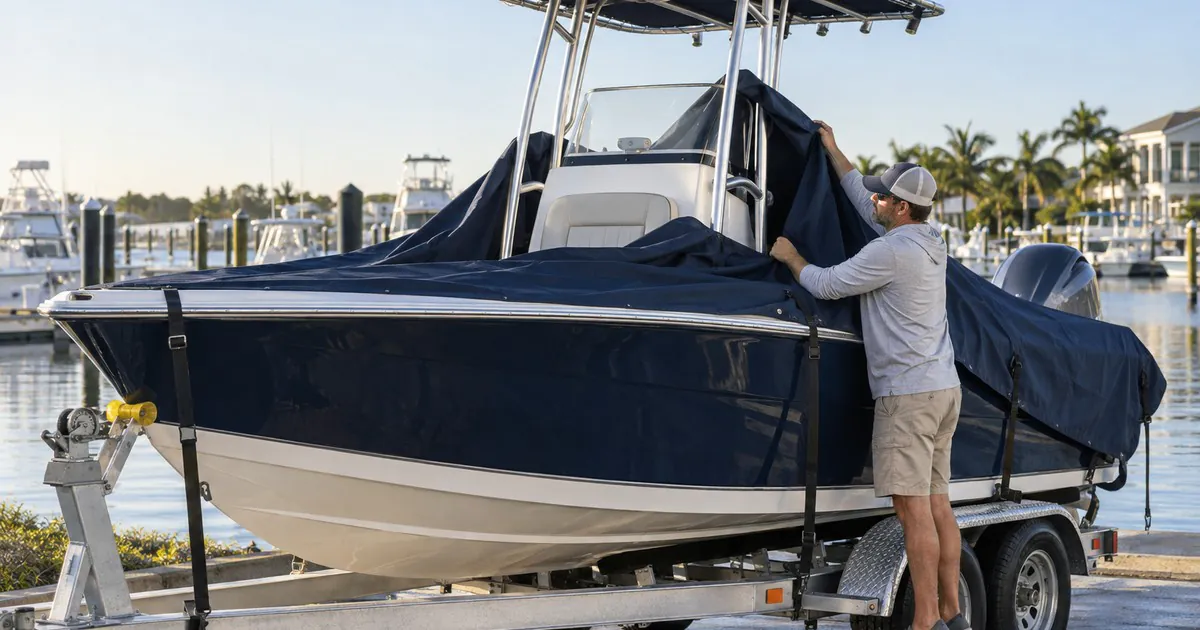
A rigid T-top changes the path a boat cover has to follow. The roof may stay above the console, the support legs can sit outside the windshield line, and rod holders, antennas, lights, or electronics may create hard contact points. A boat cover for T-top use must fit the real covered configuration without hanging from the roof, loading the frame, or leaving the hem too high along the hull.
How should a boat cover for T-top boats fit?
A boat cover for T-top boats can fit safely only when it is designed for that boat style or the roof stays inside the cover maker’s intended profile. Many center-console boats need shaped openings, zippered access, reinforced collars, or a separate console-and-T-top enclosure. Do not buy a larger generic cover just to pull it over the roof. Extra fabric can still leave pressure points, loose sides, pooling, and trailering problems.
Identify the type of cover you actually need
“T-top cover” can describe several different products. One may protect only the console and helm. Another may wrap the console, leaning post, and T-top structure. A full boat cover may use cutouts around the T-top legs while covering the hull from bow to stern. These products solve different problems, so compare the coverage area before comparing fabric or price.
Full boat cover with T-top cutouts
This style follows the hull and deck, then closes around the T-top supports. The openings should be shaped for the leg position and reinforced against movement. Look closely at how collars, zippers, hook-and-loop flaps, or boots shed water. A poorly placed opening can leak or concentrate stress even when the length range looks correct.
Console and T-top enclosure
A console enclosure protects the helm, electronics, seat, and roof structure but leaves much of the deck and hull uncovered. It can be useful for marina storage or quick protection between trips. It is not a substitute for a full cover when the goal is to protect the complete interior, bow seating, or aft deck.
Standard cover below the roof line
Some covers stop below the T-top and close around the console area. This can work only when the cover maker designed the hem, openings, and support shape for that layout. A standard motorboat cover should not be cut at home around the legs without proper reinforcement. Raw openings can spread, leak, and tear under wind load.
Measure the boat with the T-top fully configured
Measure the boat as it will sit during storage or trailering. Put antennas, outriggers, rod holders, radar, anchor lights, canvas wings, and electronics in their approved positions. Remove an accessory only when its manufacturer treats removal as a normal storage step. A clean measurement taken after temporarily stripping fixed equipment does not describe the real boat.
- Measure the centerline length from the bow to the stern point the cover must reach.
- Measure the maximum beam at the widest point of the hull.
- Record the height from the normal cover hem line to the highest fixed part of the T-top.
- Measure the outside spacing and fore-aft position of all T-top legs.
- Note rod holders, bolts, electronics boxes, lights, antennas, and sharp corners that project beyond the frame.
- Photograph the boat from both sides, the bow, the stern, and above the console before ordering a shaped cover.
Use the Safeboatz boat-cover measurement guide for the basic length, beam, and clearance sequence. The center-console cover guide adds console, windshield, bow hardware, and deck-layout checks. A model name or nominal hull length cannot replace these measurements because T-top geometry changes between model years and equipment packages.
Map every T-top contact point before adding tension
Stainless tubing looks smooth from a distance, but the cover may touch mounting bolts, welds, rod-holder tubes, zipper pulls, cable clamps, speaker brackets, antenna bases, and electronics corners. Mark each contact point while the cover is still loose. Pay special attention to the forward legs, where wind pressure often pushes fabric toward the frame.
Use stable, nonabrasive padding on raised fittings. The padding should stay in place, resist soaking up water, and avoid creating a larger hard edge. Do not wrap the whole frame in loose towels or blankets that can slide, hold moisture, or bunch beneath the fabric. If an accessory can be folded or removed normally, follow its manual rather than forcing the cover around it.
After the first windy night or short local tow, remove the cover and inspect both sides of the fabric. Polished spots, gray dust, compressed padding, or shiny marks on the tubing show movement. The boat-cover chafing guide explains how to trace rubbing before it becomes a hole.
Build drainage without hanging the cover from the roof
A T-top is a high point, but that does not automatically make it a cover support. A wet cover can pull down on the roof skin, rod holders, canvas, antennas, or electronics mounts. The frame may be strong enough for normal use while still being the wrong place for pooled-water loads or concentrated strap tension.
Use the support system approved for the cover. Create a continuous slope toward the perimeter and check the valleys between the bow, console, T-top legs, leaning post, and stern. Water often collects beside a tall console because the fabric changes direction twice in a short distance. More tension at the nearest strap rarely fixes that shape.
Stand at hull height and look across the cover before the first rain. Any flat shelf or inward fold deserves attention. Keep vents open and support poles clear of the windshield, T-top frame, wiring, and electronics. See the support-pole and pooling guide for a practical runoff check.
Close T-top openings before tightening the rest of the cover
Install a shaped T-top cover in the order specified by its maker. In many designs, the leg openings need to be aligned and closed while the main body is still loose. If the bow, stern, or side straps are tightened first, the openings can be pulled sideways and the reinforced collars may no longer sit flat.
- Center the cover on the boat and identify the front, rear, and leg openings.
- Seat each reinforced opening around the correct T-top support.
- Close zippers, flaps, or collars without trapping wires or fabric.
- Check that seams are not crossing bolts, rod holders, or the windshield edge.
- Connect tie-downs loosely, then tension opposite sides in small steps.
The hem should settle evenly along the hull. If one side climbs when a T-top opening is closed, stop and check the opening location, cover orientation, and boat measurements. Do not use one tight strap to drag the entire cover into position. The boat-cover installation guide covers the full bow-to-stern sequence.
Treat trailering as a separate fit test
A cover can sit quietly at the dock and still fail at highway speed. Confirm that the cover maker approves trailering with the T-top configuration shown. Check every opening, collar, zipper, strap, and loose edge. Antennas, outriggers, curtains, rod holders, and electronics covers must also be in their approved travel positions.
Route straps to solid trailer-frame points where they cannot touch tires, brake lines, lights, exhaust parts, or sharp brackets. Keep the cover clear of the outboard and steering hardware unless the cover is designed for that arrangement. Tighten until the surface is firm and stable, not until the T-top legs or openings distort.
Stop after a short distance in a safe place. Look for a collar working open, a strap moving toward a tire, fabric ballooning beside the console, or padding shifting off a fitting. Discover Boating’s towing and trailering checklist is a useful reminder to check the hitch, safety chains, tires, lights, tie-downs, and loose gear before the trip.
Check Storm Series compatibility from the hull profile, not the roof
Safeboatz Storm Series covers are current premium trailerable motorboat covers in 17–19 ft and 20–22 ft ranges. Those length ranges do not establish T-top compatibility. Compare the boat style, beam, console height, T-top leg positions, fixed accessories, intended hem line, and storage or trailering use before choosing a size.
If the rigid roof and support legs sit outside the normal cover profile, choose a cover specifically patterned around the T-top or request a custom fit. Buying the next size up can create loose fabric without placing the openings where they belong. A clean fit needs the right shape as well as enough length and beam.
Frequently asked questions
Can I pull a universal boat cover over an upright T-top?
Usually not. An upright T-top often sits outside the shape a universal cover was designed to follow. Use a full cover with reinforced T-top openings, a model-specific cover, or a custom solution rather than stretching fabric over the roof.
Should I cut holes in a boat cover for the T-top legs?
Not without professional reinforcement and a proven pattern. Unfinished cuts can leak, spread, and tear. A purpose-built cover uses shaped openings, reinforced edges, and closures designed around the support legs.
Can the T-top support the center of the cover?
Do not assume it can. The roof, rod holders, antennas, electronics, and mounts may not be designed for cover tension or pooled-water loads. Use the support system approved by the cover maker.
How do I stop a T-top cover from rubbing the frame?
Align the openings before tensioning, pad raised fittings with stable nonabrasive material, keep seams off hardware, balance the straps, and inspect after the first wind or short tow. Repeated rubbing usually means the cover is moving or the opening is misplaced.
Is a console cover enough for outdoor storage?
It protects the helm area but leaves much of the boat exposed. Choose it when that limited coverage matches the storage goal. Use a full cover when the bow, deck, seating, or complete interior also needs protection.
Test the complete setup before the weather does
Install the cover in dry weather, close every T-top opening, add the intended support, and tension the straps evenly. Leave it in place for several hours, then uncover the boat and inspect the frame, windshield, electronics, fabric, and padding. Repeat the check after the first rain and, when trailering is approved, after a short local tow.
For a broader storage and protection routine, download the free boat protection guide. It covers the fit, drainage, tie-down, moisture, and inspection habits that help a cover protect the boat instead of becoming another source of wear.
Boating Enthusiasts — Join the Crew!
Free Boat Protection Guide Download Yours Now
Get your free copy of The Complete Boat Protection Guide — expert tips, real-world strategies, and exclusive insights from the Safeboatz team.