 SafeBOT

Deck Boat Cover Guide: Wide Bow, Windshield & Trailering Fit
Choose a deck boat cover with fewer fit surprises. Measure the wide bow, windshield, folded bimini, swim platform, support zones, and trailer strap routes.

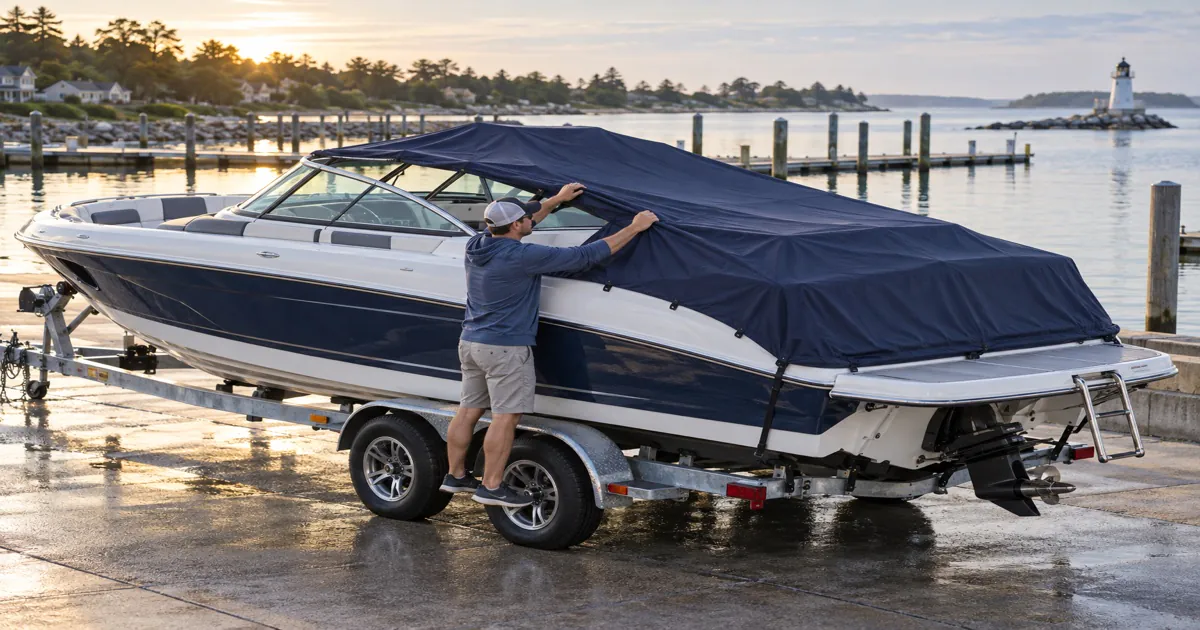
A deck boat cover has to account for more than the boat’s advertised length. Deck boats often carry their width far forward, use a broad open bow, and combine a tall windshield with a wide rear seating area or swim platform. Those features create useful space on the water, but they also create extra fabric span, several likely pooling zones, and more places where a loose cover can rub or catch air.
Start with the boat in its normal trailering or storage configuration. Measure the actual hull and permanent equipment, decide whether the bimini will be folded or removed, map the windshield and platform, and check how every tie-down will reach the trailer. A size label is only useful after those details agree with the cover maker’s fit range and intended use.
Quick answer: what makes a deck boat cover fit correctly?
A deck boat cover should follow the wide bow and cockpit without hanging in large unsupported panels. It needs enough clearance for the windshield and folded bimini, a supported slope over the bow and seating areas, a clean fit around the rear platform or outboard, and tie-down points that can be tensioned evenly on the trailer. The correct cover is the one that matches those measurements and is approved for the way you plan to use it.
Do not assume a cover fits because the boat and cover share the same nominal length. Two 20-foot boats can have different beams, windshield heights, bow shapes, platforms, rails, and bimini hardware. Those differences change where the fabric lands and how much support it needs.
Why deck boats are harder to cover than the length suggests
A typical deck boat is designed around passenger room and easy boarding. The bow may be much fuller than the pointed bow of a conventional runabout. Seating can extend close to the gunwales, and the stern may include a broad platform or molded boarding area. That creates a large horizontal area under the cover.
Large horizontal spans need deliberate support. If the cover bridges from the windshield to the bow without a raised support point, rain can settle into the open-bow seating area. The same thing can happen behind the windshield, between cockpit seats, or in front of the rear bench. Tightening the perimeter does not automatically remove those low areas.
- Wide open bow: more fabric spans across seats and walkways.
- Tall windshield: a major height and chafe point near the center of the boat.
- Folded bimini: extra height, hard joints, and possible pressure points.
- Broad stern: the cover may need to clear a platform, ladder, engine, or rear hardware.
- Trailer geometry: fenders, guide posts, steps, and frame members affect strap routing.
Measure the boat in the configuration you will cover
Measure from the forwardmost point that the cover must protect to the aft point included by the cover maker’s instructions. Do not automatically include a swim platform, outboard, bow pulpit, or trailer hardware. Some covers are sized around the hull, while others specify allowances for selected extensions. Use the manufacturer’s measurement method rather than adding inches by instinct.
Measure the beam at the widest covered point. Then record the windshield height, the folded-bimini height, and the location of any hardware that rises above the gunwale. Photograph the boat from both sides and from above if possible. The Safeboatz boat-cover measuring guide explains centerline length, beam, height, and obstruction checks in more detail.
- Put the bimini, seats, windshield door, and removable equipment in their normal covered positions.
- Measure the centerline length using the cover maker’s start and end points.
- Measure the maximum beam, not only the beam listed in a sales brochure.
- Record the windshield and folded-bimini height above the gunwale.
- Note swim platforms, ladders, outboards, rails, cleats, and navigation lights.
- Map the trailer frame and the places where tie-down straps can run without rubbing.
Decide what to do with the bimini before choosing the cover
A raised bimini should not be treated as a support frame for a general boat cover. Wind load and pooled water can place forces on the bimini that it was not designed to carry. In most storage or trailering setups, the bimini is folded or removed according to its maker’s instructions before the main cover goes on.
A folded bimini still changes the fit. Measure its stored height and width, pad hard joints, and confirm that the cover can pass over it without becoming a single high ridge with flat valleys on both sides. For a more detailed sequence, use the boat-cover-with-bimini guide.
Protect the windshield without building a pooling valley
The windshield is often the highest fixed point on a deck boat. It can help define the cover’s shape, but it should not carry concentrated fabric tension at sharp corners. Use smooth, secure padding where the cover crosses exposed frame corners, latches, or the center walkthrough. Padding should not hold water against the frame or slide away as the cover is tensioned.
Look at the fabric immediately in front of and behind the windshield. Those are common low zones. A support system should create a continuous path for runoff instead of letting water stop at the windshield base. If one pole creates a sharp peak while the bow and cockpit remain flat, add or reposition support according to the cover instructions.
Support the open bow and cockpit separately
The open bow is one reason deck boats need a thoughtful support plan. Fabric can span across the forward seating area and sink between the cushions. The cockpit has the same problem on a larger scale. Treat them as separate drainage zones connected by a smooth overall slope.
Use the support poles, bows, ridge line, or frame intended for the cover. Keep pole tops protected and positioned over structurally suitable areas. Do not place a narrow pole directly against upholstery or thin fabric without the correct cap and reinforcement. The boat-cover support pole guide covers pressure points, pole height, and runoff checks.
After installation, test the shape with controlled water. Watch the bow, the space behind the windshield, the center walkway, and the rear seating area. Correct every pocket before leaving the boat outside. Recheck after the first hard rain because fabric and straps can settle.
Check the stern, swim platform, and outboard clearance
Deck-boat stern layouts vary widely. One boat may have a molded platform and sterndrive. Another may use an outboard bracket, rear ladder, tow eye, or extended platform. Confirm what the cover is designed to enclose and what remains outside it.
A cover that is pulled over a platform it was not sized to include may ride too high at the stern and lose tension along the sides. A cover that stops ahead of the platform needs a clean aft edge that does not rub on hinges, ladder mounts, or seat corners. Keep the propeller and lower unit out of the main cover unless the cover is specifically designed for that arrangement.
Route tie-downs for the trailer, not around it
Before trailering, every strap needs a clear route to a suitable attachment point. Avoid sharp trailer edges, hot or moving components, tires, brake lines, and places where the strap can flap against the hull. Deck-boat trailers may have wide fenders, steps, or guide posts that make the shortest route a poor route.
Apply tension gradually and move around the boat instead of tightening one side completely. The perimeter should sit evenly without pulling the cover away from the bow or stern. Loose fabric can catch air; excessive local tension can overload a seam, buckle, or windshield contact point. Review the boat-cover strap routing guide before the first tow.
Stop after a short initial drive in a safe location and inspect the cover. Look for lifted edges, new wrinkles, shifting padding, loose strap tails, or fresh rub marks. A trailering cover still requires the speed limits, inspection intervals, and setup described by its manufacturer.
Storage fit and trailering fit are not identical
A cover can look acceptable in a driveway and still be unsuitable for road use. Outdoor storage emphasizes runoff, ventilation, UV exposure, wind, and periodic checks. Trailering adds sustained airflow, vibration, strap movement, and the need to keep the cover stable at road speed.
Verify the intended use before towing. If a cover is sold only for storage or mooring, do not turn it into a trailer cover by adding more straps. If the boat will remain outside, dry the interior before covering and keep vents near supported high points. The boat-cover ventilation guide explains how support and airflow work together.
When a custom or semi-custom deck boat cover makes sense
A standard cover is easier to consider when the deck boat has a simple profile, measurements within the stated range, a folded bimini that fits beneath the intended contour, and clear trailer tie-down routes. A custom or model-specific cover becomes more attractive when the boat has an unusually broad bow, tall windshield, permanent arch, complex platform, fixed hardware, or several areas that resist a smooth supported slope.
Ask how the cover handles the exact boat configuration, not only the model name. Model-year changes can alter windshields, seating, rails, platforms, and engine layouts. Confirm support, ventilation, attachment points, intended use, and repair options before ordering.
How Storm Series fits into the comparison
The current Safeboatz Storm Series covers are premium trailerable-cover options. The Storm Series 17-19 ft trailerable boat cover and Storm Series 20-22 ft trailerable boat cover provide current size-range and ratchet-secured construction references.
Length alone does not confirm deck-boat compatibility. Compare your centerline length, maximum beam, windshield height, folded-bimini profile, platform, outboard arrangement, and trailer strap routes with the live product information. If any measurement or obstruction falls outside the stated fit, use a different cover rather than forcing the fabric around the boat.
Deck boat cover checklist
- Measure actual centerline length and maximum covered beam.
- Record windshield and folded-bimini height.
- Confirm whether the platform and outboard are included in the fit method.
- Pad windshield corners and other hard contact points.
- Support the bow, cockpit, and rear seating zones so rain can run off.
- Route every tie-down clear of tires, sharp edges, heat, and moving parts.
- Verify the cover is approved for storage, trailering, or both.
- Test runoff before outdoor storage.
- Inspect after the first rain and after a short initial tow.
FAQ
Can I use a universal cover on a deck boat?
A universal cover may work if the actual length, beam, height, stern layout, and intended use fall within its specifications. Deck boats vary enough that the model length alone is not a reliable fit check.
Should the bimini stay up under the cover?
Usually no. Follow the bimini and cover makers’ instructions. A raised bimini should not be assumed to support a general cover. Fold or remove it as directed, then measure and protect the stored hardware.
How do I stop water pooling in the open bow?
Use the intended support system to raise the fabric and create a continuous drainage path. Test with controlled water and adjust every low area before leaving the boat outside.
Does a deck boat cover include the swim platform?
It depends on the cover’s measuring instructions. Some fits stop at the transom; others allow selected platform styles. Do not add platform length unless the maker tells you to include it.
Can I trailer with the same cover used for storage?
Only if the cover is approved for trailering and can be secured according to its instructions. Storage-only covers are not made road-ready by simply tightening them harder.
Make the fit decision at the boat
Bring the measurements, photos, and trailer layout together before ordering. The right deck boat cover should protect the wide bow and cockpit without creating unsupported valleys, clear the windshield and stored bimini, sit correctly at the stern, and tension evenly on the trailer. If the cover requires force or improvisation to get around the boat’s permanent features, the fit is wrong.
For a broader storage, trailering, and protection checklist, download the free Safeboatz Boat Protection Guide.
Boating Enthusiasts — Join the Crew!
Free Boat Protection Guide Download Yours Now
Get your free copy of The Complete Boat Protection Guide — expert tips, real-world strategies, and exclusive insights from the Safeboatz team.