 SafeBOT

Pontoon Boat Cover Fit: Playpen, Deck & Measuring Guide
Measure a pontoon boat cover correctly: compare playpen and full-deck coverage, record fence and bimini dimensions, check replacement fasteners, and confirm trailering approval.

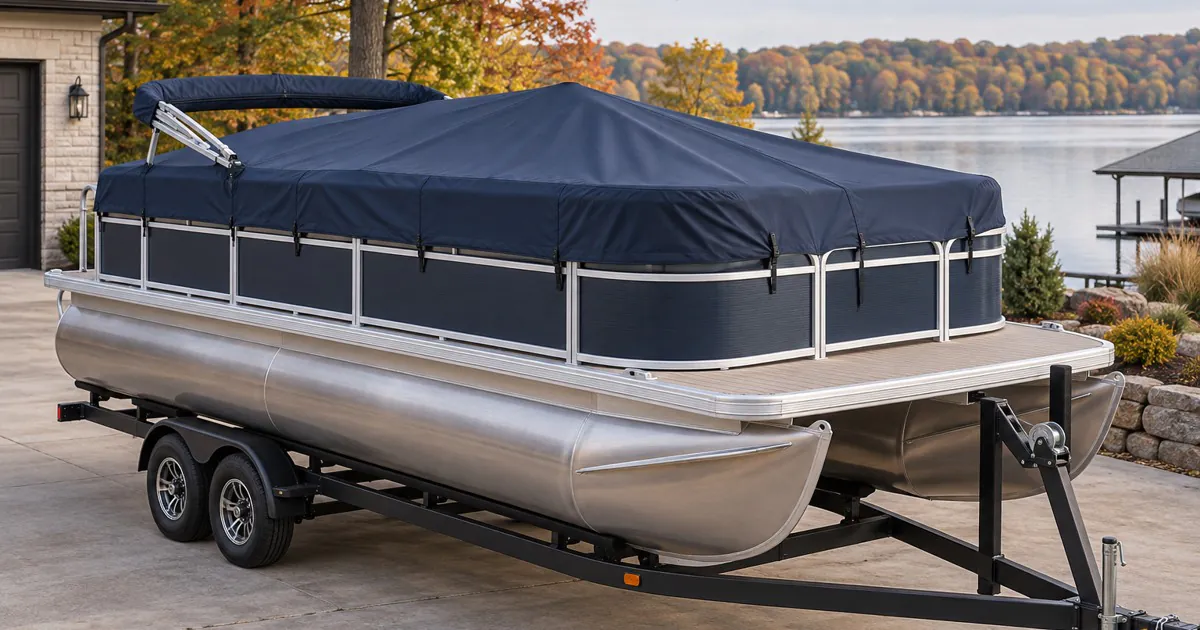
A pontoon boat cover can match the length printed on your registration and still be the wrong shape. The cover may need to fit the fenced seating area, the entire deck, or a specific arrangement of gates, rails, and bimini hardware. Those are different footprints. Before you order, decide what you want covered and measure that area using the cover maker’s instructions.
This guide focuses on pontoon-specific fit decisions: playpen versus full-deck coverage, the measurement sheet to send a seller, snap alignment, support placement, and the separate approval needed for trailering. It is a planning checklist, not a compatibility certificate for a particular boat or cover. Your boat manual and the instructions for the exact cover take priority.
Which part of a pontoon should the cover fit?
A playpen cover generally protects the fenced seating area. A full-deck cover may extend farther forward or aft, depending on its pattern. Record the deck length, fenced-area length, maximum width, rail height, and folded bimini position separately. Then confirm which measurements the seller uses. Do not substitute pontoon-tube length or a model number for the required cover dimensions.
Think about the front platform on your own boat. If that platform sits outside the fence, a cover that ends at the front rail will leave it exposed. That may suit your storage plan, but you should make that choice before buying. A larger size is not a reliable way to turn a playpen pattern into a full-deck pattern.
Start with the job, not the size label
Write down where the pontoon will spend most of its covered time. A dockside cover has to be installable from the dock. A cover used on a trailer needs reachable attachment points and clearance around the frame. A boat kept under a roof still needs a plan for dust, damp upholstery, and access. The same cover may not solve every situation.
- For regular dockside use, check how you will close the far side without climbing outside the rails.
- For outdoor storage, ask whether the cover and support arrangement suit the expected weather, including any winter limitations.
- For road travel, require explicit trailering approval for the exact cover and boat configuration.
- For a replacement snap-on cover, identify the model year, floor plan, fastening system, and any changes to the rails or bimini.
The Bennington 2020–2021 owner’s manual separates mooring covers from trailering covers and warns against using its mooring cover for trailering or winter storage. This is an example of a manufacturer-specific restriction, not a universal rule for every pontoon cover. Check the current manual for your own boat and the instructions for its exact cover.
Build a pontoon boat cover measurement sheet
Park the boat safely and use a helper for long measurements. Follow the seller’s directions about straight-line dimensions versus measurements over the boat’s profile. Do not add an allowance unless those directions request one. Use one unit throughout the sheet and keep the original measurements rather than rounding them into a convenient size range.
Deck and fenced seating area
Record the front-to-back deck dimension and the front-to-back fenced-area dimension separately. Note where the fence starts relative to the bow deck and where it ends relative to the aft platform. Photograph those boundaries. A seller can answer a coverage question much more clearly when the measurements and photographs describe the same footprint.
Width, rails, and gates
Measure the width at the locations the cover maker specifies. Also record the widest relevant point, rail height, and any projection outside the fence. Identify front, side, and rear gates, including their hinges and latches. If an existing snap track follows a curved corner, include a photograph of that corner rather than assuming a straight rectangular outline captures the whole fit.
Bimini and other hardware
Put the bimini in the position approved for the intended use before measuring. A folded frame can sit above the rails, lie along the rear seating area, or remain outside the covered footprint. Include its brackets and resting position. Check removable tables, fishing seats, rail-mounted accessories, and anything that creates a hard contact point. Our bimini-cover fit guide explains why the stored configuration matters.
Stern and motor boundary
Ask whether the intended pattern stops at the rear fence, covers the aft platform, or includes a separate motor area. Record the motor position specified by the boat and engine instructions. A cover should not require you to place the engine in an unsuitable position merely to make the fabric reach. Do not assume the motor is included because a listing mentions boat length.
Send the seller your boat’s make, model, model year, floor plan, these measurements, and clear side, bow, and stern photographs. Mention aftermarket changes. Our general boat-cover measurement guide provides the broader checklist; on a pontoon, the deck and fence boundaries deserve their own entries.
Choose the pattern and fastening system together
A model-specific replacement is often worth investigating when the boat already has a complete snap or clip system. Confirm the precise year and layout, not just the brand. Boats with the same marketed length can have different gates, rail shapes, lounges, and bimini locations. Existing fasteners do not prove that an unrelated replacement cover will line up.
A universal or semi-custom cover needs a different conversation: its listed shape, coverage boundary, width allowance, height allowance, and permitted attachment method all matter. Avoid choosing it solely because the label spans your boat’s nominal length. If the maker cannot confirm the required dimensions or use, seek a better-documented pattern or a marine canvas professional.
Do not drill new holes or move factory fasteners as a first response to poor fit. Recheck the cover identity, orientation, support height, and installation sequence first. A mismatched pattern may pull correctly at one corner and strain the opposite side. Forcing it closed can hide the mismatch while loading the fabric and hardware.
Support the broad span without stretching the cover
Pontoon seating areas create a broad space under the cover. During a dry trial fit, look for low panels between the rails and supports. Use the support system specified for that cover and adjust it in the recommended order. The aim is a water-shedding shape with supported fabric, not a tall center peak that makes the perimeter hard to close.
Inspect each support base and cap. The base should sit on a suitable surface without threatening upholstery or deck finish, and the cap should not create a small sharp pressure point. Stop if a pole slips, tips, or presses a seam against hardware. Read our support-pole guide for general support checks, then follow the pontoon cover’s own placement instructions.
Keep ventilation openings unobstructed and dry the interior before closing the boat. EPA’s mold guidance identifies moisture control as the basis of prevention. It is general guidance, not a marine-canvas cleaning recipe. Use approved products for your upholstery and fabric, and investigate recurring dampness rather than masking it with fragrance.
Trial-fit from the place you will install it
A cover can be manageable on a trailer and awkward at a wet slip. Before leaving it installed for a long period, rehearse the whole process in the real location. Identify where you will place the supports, which edge closes last, and how you will reach that edge safely. Do not climb onto a slippery rail or stretch over open water to make an unsuitable system work.
At the dock, keep mooring lines and cleats accessible for inspection. Check whether the fabric bears on a cleat, gate latch, or folded hinge. Use suitable protection only where the cover maker permits it; improvised padding can shift or hold water. The mooring-cover guide covers dock access and line clearance in more detail.
After the first ordinary rain, inspect from a safe position for standing water, displaced supports, new rub marks, and damp upholstery. Do not yank a loaded cover or push a large water pocket into the boat. Follow the maker’s safe drainage directions and get help if the load is substantial. Review the support shape before the next rain.
A playpen cover is not automatically a trailering cover
Storage fit and towing suitability are separate decisions. A cover that closes neatly around the fence still needs explicit road-use approval. Ask about the approved support arrangement, bimini position, fastening method, and any stated operating limits. If the instructions prohibit trailering, remove the cover for road travel and secure it separately as directed.
For an approved setup, inspect every attachment and keep straps away from tires, moving parts, sharp trailer edges, and lights. The boat’s trailer restraints remain a separate system; cover fasteners do not secure the boat to the trailer. Follow the trailer, boat, and cover manuals rather than copying a strap route from a photograph.
Safeboatz’s current Storm Series 17-19ft and Storm Series 20-22ft pages describe the current cover options. Those length labels do not establish pontoon compatibility. Before considering either for a pontoon, ask Safeboatz to verify the boat’s shape, width, hardware, coverage needs, and intended use. Choose a pontoon-specific or custom solution if compatibility cannot be confirmed.
Pontoon boat cover questions
Do I measure the deck or the pontoon tubes?
Use the dimensions required by the specific cover maker. Record deck length, fenced-area length, and width separately so you can clarify the intended footprint. Tube length alone does not describe the covered seating area or the position of its hardware.
Does a playpen cover protect the front deck?
Not necessarily. A playpen pattern generally follows the fenced seating area and may leave the platform outside the front fence exposed. Check the exact coverage diagram and ask the seller where the front edge ends.
Can I trailer with a snap-on pontoon cover?
Only if the maker explicitly permits trailering with that exact cover and configuration. Snaps alone do not prove road-use suitability. Confirm the support, bimini, fastening instructions, and restrictions before towing.
Will a bigger cover solve a bimini clearance problem?
Not reliably. Extra length can leave loose fabric while the frame still conflicts with the pattern. Measure the approved stored bimini position and choose a cover designed to accommodate it.
When should I ask a canvas shop for a custom fit?
Consider professional canvas work when the rails or layout have changed, replacement fasteners do not align, dockside access is impractical, or no documented pattern matches your boat and use. Send measurements and photographs before requesting a quote.
Before you place the order
Put the measurement sheet, boat details, coverage boundary, hardware photographs, and intended use in one message to the seller. Ask for written fit guidance and read the return conditions before ordering. That is more useful than choosing a size range and hoping the fence, gates, and bimini will fit underneath it.
For the rest of your storage routine, get the free Safeboatz Boat Protection Guide. Keep the boat-specific manuals with it so cover care and mechanical winterization remain separate, documented jobs.
Boating Enthusiasts — Join the Crew!
Free Boat Protection Guide Download Yours Now
Get your free copy of The Complete Boat Protection Guide — expert tips, real-world strategies, and exclusive insights from the Safeboatz team.