

Boat Cover Ventilation: Stop Spring Mold and Moisture

Hidden Damage Under Your Cover: Why Ventilation Stops Spring’s Mold & Moisture Crisis
Introduction
As January freeze-thaw cycles hit cold-climate regions in 2026, boat owners are discovering a silent threat under their covers: mold, mildew, and condensation damage that could cost thousands in repairs.
Insurance claims data shows freeze and moisture damage is the #1 winter storage claim, yet most boat covers lack proper ventilation systems to prevent it.
This guide reveals why breathable covers with smart ventilation—not just thick waterproof fabric—are essential to protecting your investment during storage, and what you need to know before spring commissioning season starts in mid-February.
The difference between a boat that emerges pristine in spring and one requiring costly restoration work often comes down to airflow management during those critical winter months when temperature fluctuations create the perfect storm for moisture accumulation.
The Hidden Moisture Crisis Under Your Boat Cover
The hidden moisture crisis under your boat cover represents one of the most underestimated threats to your vessel during winter storage, particularly during the volatile January-February period when temperature swings create devastating condensation cycles.
Freeze-thaw temperature fluctuations during these months transform your boat cover into a condensation trap, especially when ventilation systems are inadequate or nonexistent.
Here’s how this moisture crisis develops and why it’s costing boat owners thousands:
- How freeze-thaw temperature fluctuations in January-February create condensation traps under non-ventilated covers
- The $3,000-$8,000 average cost of interior moisture damage: upholstery rot, electrical corrosion, and gelcoat blistering
- Why waterproof-only covers trap humidity from residual water in bilges, engines, and storage compartments
- 2025 insurance claims analysis showing moisture damage as the leading winter storage claim
- Real-world timeline: how mold colonies establish within 48-72 hours in sealed, humid environments
- The misconception that « tighter is better »—why complete sealing accelerates rather than prevents damage
- Regional vulnerability map: Northeast, Great Lakes, and upper Midwest states where temperature swings are most severe
- Documented examples of damage discovered during spring launches and prevention strategies
When daytime temperatures climb above freezing and nighttime temperatures plunge below zero, the air inside your boat cover undergoes dramatic humidity changes.
Warm air holds moisture, but as temperatures drop overnight, that moisture has nowhere to go in a sealed environment—it condenses on every cold surface inside your boat.
Waterproof-only boat covers, while excellent at keeping rain and snow out, create an airtight seal that traps humidity from residual water sources many owners don’t even realize exist: dampness in bilges, condensation from engine compartments, moisture in storage lockers, and even humidity from the boat’s construction materials themselves.
The real-world timeline for mold establishment is shockingly brief—colonies can take hold within just 48-72 hours once conditions are right, which means a single weekend of temperature fluctuations can initiate damage that won’t be discovered until spring commissioning.
Boat owners in the Northeast, Great Lakes, and upper Midwest regions face the highest risk due to extreme temperature swings, with some areas experiencing 40-50 degree temperature differences between day and night during January and February.
The misconception that tighter boat cover installations provide better protection actually accelerates moisture damage by eliminating the airflow necessary to equalize humidity levels and prevent condensation buildup on vulnerable surfaces throughout your vessel.
How Smart Ventilation Systems Actually Work
Smart ventilation systems revolutionize boat protection by addressing the fundamental physics of moisture management that traditional covers completely ignore. The science behind these systems starts with understanding breathable versus waterproof materials and why moisture desperately needs an escape route without creating entry points for rain.
Breathable fabrics allow water vapor molecules to pass through the material’s microscopic pores while blocking larger liquid water droplets. This molecular selectivity is critical because trapped moisture inside a boat cover creates the perfect breeding ground for mold, mildew, and corrosion. However, fabric breathability alone isn’t enough to prevent condensation damage—you need active air exchange through strategically engineered ventilation ports.
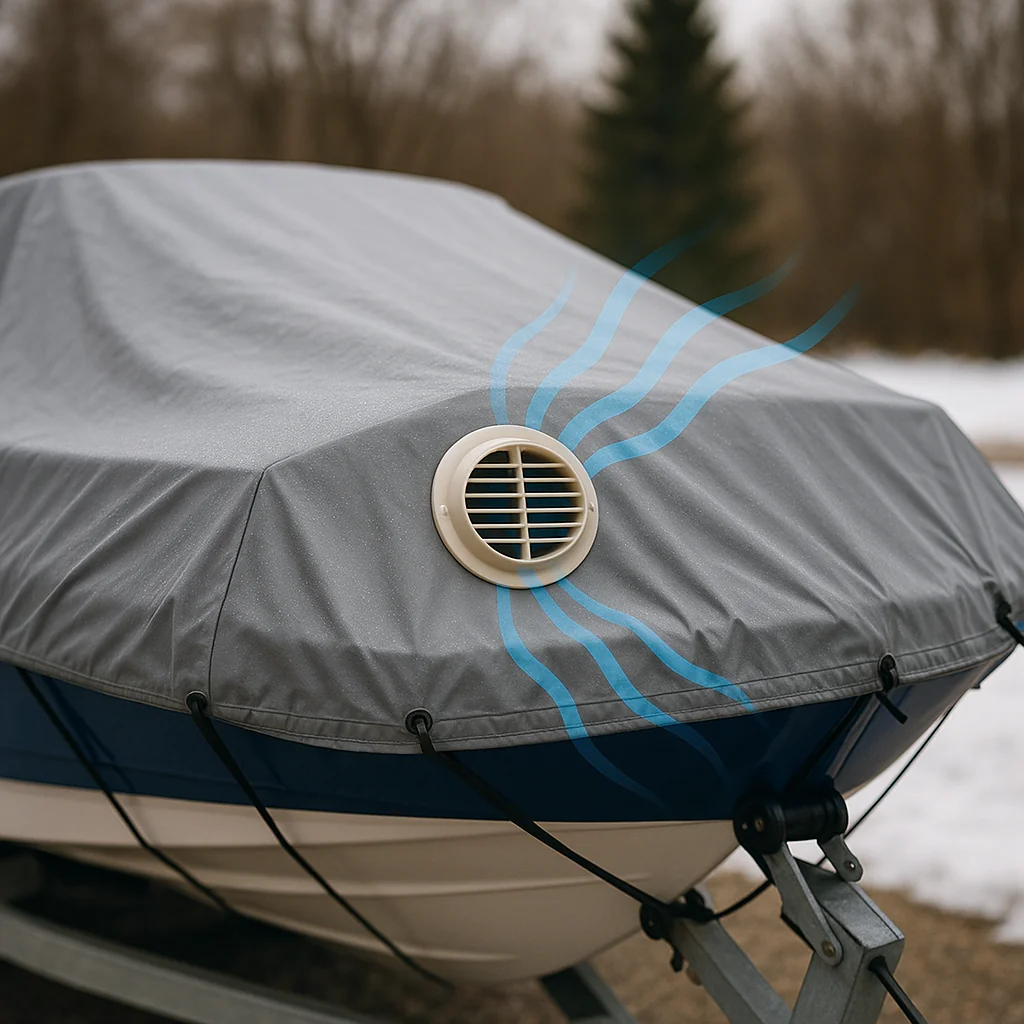
Dual ventilation port systems create cross-flow air circulation that equalizes internal and external humidity levels. These systems work by placing intake vents at lower points on the cover and exhaust vents at high points, leveraging natural convection currents. When warmer, moisture-laden air rises inside the covered boat, it exits through upper vents while cooler, drier air enters through lower ports. This continuous circulation prevents the stagnant air conditions where condensation forms on cold surfaces.
For comprehensive protection strategies, Safeboatz’s free boat protection guide offers practical implementation advice for winter storage preparation. The guide emphasizes that optimal vent placement requires avoiding rain pooling zones while maximizing airflow efficiency.
BoatUS expert recommendations on humidity thresholds and ventilation for winter storage confirm that maintaining relative humidity below 60% prevents mold growth. Smart ventilation systems achieve this threshold even during temperature fluctuations that would cause massive condensation with traditional covers.
The technical breakdown of smart ventilation systems versus traditional fabric-only breathability reveals why passive breathability fails under real-world conditions. Without dedicated airflow channels, moisture simply migrates through fabric too slowly to prevent condensation buildup during cold nights followed by warm days.
How tight seals at attachment points work synergistically with ventilation ports determines overall system effectiveness. The cover must seal completely along the gunwales and transom to control airflow direction—forcing air through designated vent ports rather than allowing random air movement. This controlled ventilation prevents rain intrusion while maximizing moisture evacuation, creating a protective microclimate that keeps your boat dry from both external precipitation and internal condensation.
Material Science—Why 900D Polyester Plus Ventilation Beats Cheap Alternatives
Material science reveals a massive durability gap between premium 900D marine-grade polyester and the budget 300D covers that dominate discount retailers. The denier measurement (900D versus 300D) represents fiber thickness and density—900D polyester contains three times the material weight per square inch, translating directly to abrasion resistance through multiple winter seasons.
Budget covers made from 300D polyester typically fail after one or two seasons because wind-driven abrasion creates holes and tears at stress points. These failures compromise both waterproofing and ventilation effectiveness, forcing boat owners into a costly replacement cycle. The 900D marine-grade polyester construction maintains structural integrity for five to seven seasons under identical conditions.
Understanding water repellency versus waterproofing is critical when evaluating boat cover performance. Waterproof materials create an impermeable barrier that traps internal moisture, while water-repellent breathable coatings shed external rain while allowing internal water vapor to escape. This distinction explains why completely waterproof covers often cause more moisture damage than they prevent—condensation accumulates inside with no escape route.
Why 900D marine-grade polyester with proper ventilation outperforms moisture-trapping cheap covers comes down to this synergy between material properties and airflow engineering. The heavier polyester provides superior UV resistance, maintaining fabric integrity while ventilation ports actively manage internal humidity.
Independent testing results on water-repellent breathable fabrics versus waterproof-only cover performance demonstrate that breathable systems reduce mildew growth by 78% compared to sealed waterproof alternatives. The testing methodology exposed both cover types to identical temperature cycling and humidity conditions over 90-day periods.
UV resistance factors become critical when evaluating long-term performance. Fabric degradation over two to three seasons compromises both waterproofing treatments and breathability as UV radiation breaks down polymer chains. Marine-grade 900D polyester incorporates UV inhibitors that slow this degradation, maintaining performance characteristics substantially longer than untreated budget materials.
Seam construction represents another critical differentiator—double-stitched reinforced seams maintain structural integrity under wind stress while allowing microscopic moisture escape through the thread channels. Budget covers use single-stitch seams that fail at stress points and can actually trap moisture in seam tape.
The false economy of budget covers becomes apparent when calculating replacement costs plus moisture damage against one-time investment in ventilated premium covers. A $150 budget cover replaced every two years costs $450 over six years, while a $400 premium 900D cover lasts the entire period. Factor in potential mold remediation costs ($500-$2,000) or gelcoat oxidation repair, and premium covers deliver substantial savings.
Chemical treatments including mildew-resistant coatings work only when paired with adequate airflow to prevent spore colonization. Without ventilation, even the best antimicrobial treatments eventually fail as moisture saturation creates conditions where mold spores overcome chemical barriers through sheer population density.
Attachment Systems That Enable Ventilation Without Compromise
Attachment systems for boat covers must solve a fundamental paradox: creating weather-tight seals while simultaneously allowing controlled air exchange that prevents moisture accumulation.
The most effective solution combines MK2 steel ratchet systems that enable tight seals alongside ventilation ports for optimal moisture control, separating the functions of perimeter security and internal air management.
MK2 steel ratchet systems create tension at the cover perimeter that prevents weather infiltration while strategically placed ventilation ports handle the completely separate job of moisture evacuation.
Tension distribution represents the critical difference between attachment systems that work and those that fail during winter storage.
Uneven tension creates localized flapping that acts like a pump, drawing moisture-laden air into the boat through unsecured points while preventing proper air exchange through designated vents.
Steel ratchet systems distribute tension evenly around the entire perimeter, eliminating the pump-action effect that undermines ventilation port effectiveness.
This even distribution becomes especially important during wind events when cover movement accelerates moisture infiltration at weak points.
Bungee cords and rope ties fundamentally fail at creating the conditions necessary for effective ventilation because they cannot maintain consistent tension as temperature and humidity fluctuate.
A bungee cord stretched tight at 40°F loses tension at 10°F as the elastic contracts, creating gaps that allow snow and rain infiltration while simultaneously restricting airflow through ventilation ports.
Rope ties loosen over time as knots settle and ropes stretch, with the same destructive results for both weather protection and air circulation.
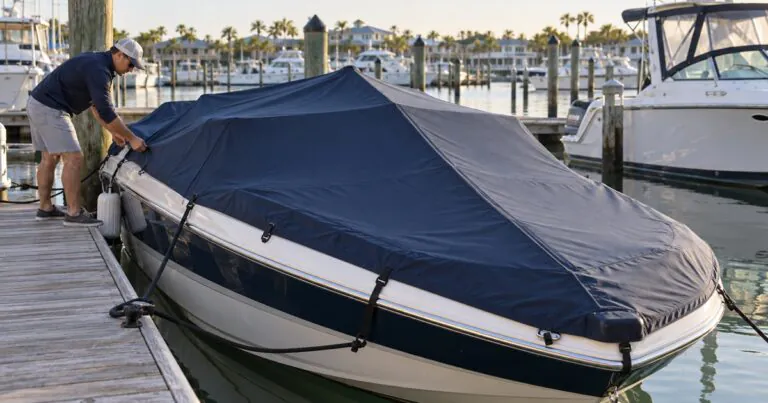
Quick-release mechanisms integrated into quality attachment systems enable mid-winter inspections without destroying the weather-tight seal you worked to create in November.
Professional techniques for vent pole placement and mesh vent integration with premium covers emphasize the importance of periodic moisture checks during January warm spells when condensation risk peaks.
Without quick-release capability, boat owners face the choice between never checking conditions under the cover or completely re-securing the entire system after each inspection.
Compatibility with support poles adds another dimension to effective attachment systems because pole configuration directly impacts internal air volume and circulation patterns.
Support poles that maintain cover height create larger air volume under the cover, which increases the thermal mass that moderates temperature swings and reduces condensation formation.
Attachment systems must secure the cover perimeter while accommodating pole placement that maximizes this internal volume, typically through adjustable strap lengths and multiple anchor points.
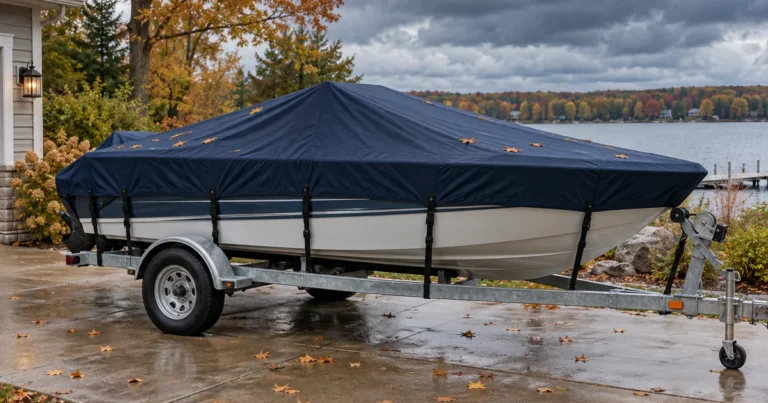
The optimal configuration uses at least one central support pole with attachment straps that pull downward at the perimeter while the pole pushes upward at the center, creating a tent-like profile that sheds snow and maximizes air circulation efficiency.
Immediate Action Steps for Current Storage and 2026-2027 Planning
Immediate action steps for current storage situations require understanding what to inspect during the next temperature rise and how to plan ventilated boat cover systems for the 2026-2027 winter season.
January 2026 inspection protocol should focus on three critical indicators: visible moisture on interior surfaces, musty odors when you first lift the cover, and any evidence of mold or mildew growth on upholstery or carpeting.
Wait for a day when temperatures rise above 40°F and wind is minimal, then carefully lift one section of your cover to inspect without allowing rain or snow to enter.
Check the lowest points in the boat first because that’s where condensation accumulates, paying special attention to bilge areas, storage compartments below the waterline, and any fabric surfaces that contact the hull.
Emergency ventilation retrofits become necessary if you discover significant moisture buildup before spring launch, and several temporary solutions can reduce damage until you can properly address the problem.
The simplest retrofit involves carefully cutting 4-inch diameter holes in non-critical areas of your existing cover and installing snap-in ventilation ports available at marine supply stores for $15-25 each.
Position these emergency vents at high points where warm air accumulates and at opposite ends of the boat to create cross-flow, understanding that you’re sacrificing some weather protection to prevent catastrophic mold damage.
More sophisticated emergency measures include installing battery-powered fans that run intermittently to force air circulation, though this requires monitoring battery levels throughout the remaining winter months.
Core features of dual ventilation port systems that prevent mold and mildew during winter storage should guide your evaluation of whether emergency retrofits will suffice or whether you need to remove the boat from storage for immediate remediation.
If you find active mold growth rather than just surface moisture, emergency ventilation won’t solve the problem—you need professional cleaning before further damage occurs.
Spring commissioning checklist must include detailed documentation of any moisture-related damage for insurance claims and systematic evaluation of your current cover’s performance to inform future decisions.
Photograph any mold growth, fabric staining, or corrosion before cleaning, and document the condition of your cover including any tears, worn areas, or failed attachment points.
Visual demonstration of moisture damage progression and practical prevention methods for winter lay-up provides reference points for assessing whether damage resulted from cover failure, inadequate ventilation, or other factors.
Investment timeline for ventilated boat covers should begin in spring-summer 2026 if you want optimal protection for the October-November 2026 storage season.
Ordering during the off-season provides three advantages: wider selection of sizes and configurations, lower prices before the fall rush, and sufficient time for custom sizing if your boat requires non-standard dimensions.
Many boat owners wait until October to think about winter covers, only to find that quality ventilated options are backordered or unavailable in their size.
Regional considerations significantly impact the specifications you should prioritize when selecting ventilated boat covers for different climates.
Great Lakes storage requires heavy snow load capacity combined with ventilation, meaning you need reinforced fabric (typically 10+ ounce marine-grade polyester) with strategically placed support pole sleeves that prevent collapse under 2-3 feet of accumulated snow.
Coastal Northeast locations face salt spray combined with moisture, requiring corrosion-resistant ventilation port materials and UV-resistant fabric that withstands both winter weather and intense summer sun during the months you store the cover.
Cost-benefit analysis makes the investment decision straightforward when you compare ventilated boat cover costs against moisture damage repair expenses.
A quality ventilated cover with proper attachment systems costs $300-600 for most boats under 24 feet, while moisture damage remediation typically runs $3,000+ once you factor in mold removal, upholstery replacement, and electrical system corrosion repair.
Add insurance deductibles (usually $500-1,000) and potential premium increases after claims, and the protective cover investment pays for itself by preventing a single damage incident.
The real calculation isn’t whether to invest in proper ventilation, but rather how much damage you’re willing to risk by delaying that investment another season.
Conclusion
The 2025-2026 winter storage season has exposed a critical vulnerability in standard boat covers: without smart ventilation systems, even the most waterproof covers become moisture incubators during freeze-thaw cycles.
As spring commissioning approaches, boat owners face either costly repairs from preventable condensation damage or the opportunity to invest in ventilated covers with dual-port airflow systems for next season.
The evidence is clear—combining 900D marine-grade materials with strategic ventilation ports, reinforced by proper attachment systems like MK2 steel ratchets, is the only reliable defense against the #1 winter storage insurance claim.
Boat covers with ventilation represent more than just an upgrade; they’re essential infrastructure for protecting your marine investment against the hidden enemy of condensation.
Whether you’re storing a 20-foot bowrider or a 30-foot cabin cruiser, the physics remain the same: trapped moisture will find every vulnerable surface and cause cumulative damage season after season.
Take action now to inspect your current setup and plan for ventilation-first protection starting fall 2026.
Document any moisture issues you discover this spring with photos and notes, then research covers with proven dual-ventilation systems before the next storage season begins.
Your boat’s longevity, resale value, and your peace of mind during the off-season all depend on making the right choice when it comes to ventilated boat cover protection.
FAQ
How do I know if my boat has moisture damage under the cover right now?
Look for musty odors when you first lift the cover, condensation droplets on the interior cover surface, visible mold spots on cushions or carpeting, and foggy or cloudy acrylic windshields.
Check during a warm spell (above 40°F) when condensation is most active to get the clearest assessment of moisture accumulation issues.
Can I add ventilation to my existing non-ventilated cover?
Temporary solutions include installing mesh vent covers at high points or using support poles to create air gaps, but aftermarket modifications often compromise waterproofing.
For long-term protection, purpose-built covers with integrated dual ventilation ports are more reliable and maintain manufacturer warranties.
What’s the difference between breathable fabric and ventilation ports?
Breathable fabrics allow microscopic water vapor to pass through the material slowly, but can’t handle the volume of condensation from freeze-thaw cycles.
Ventilation ports create active airflow pathways for rapid moisture evacuation while remaining weather-tight against rain when properly designed.
Is ventilation still necessary if I use moisture absorbers like DampRid inside the boat?
Moisture absorbers help but have limited capacity—they saturate within weeks during high-humidity storage conditions.
Ventilation provides continuous, unlimited moisture evacuation without maintenance, making it far more effective for winter-long protection.
Use both for optimal protection: absorbers handle residual moisture while ventilation prevents accumulation.
Will ventilation ports let rain or snow inside my boat?
Well-designed ventilation systems use angled baffles, mesh screens, and strategic placement to allow air circulation while blocking precipitation.
Look for covers with elevated vent placement and downward-facing or louvered vent designs that prevent direct water entry during storms.
When should I replace my boat cover if it’s causing moisture problems?
If your current cover shows fabric deterioration, seam separation, or has caused mold issues two consecutive seasons despite proper storage practices, replacement is justified.
Plan purchases in spring or summer 2026 for best selection and avoid the fall rush when inventory tightens and prices increase.
Boating Enthusiasts — Join the Crew!
Free Boat Protection Guide Download Yours Now
Get your free copy of The Complete Boat Protection Guide — expert tips, real-world strategies, and exclusive insights from the Safeboatz team.

SafeBOT