 SafeBOT

Spring Boat Launch Damage 2026: What Your Cover Prevented

Spring Boat Launch Damage Report 2026: What Your Winter Cover Prevented (or Didn’t)
Introduction
Spring 2026 boat damage discoveries are revealing a harsh truth about winter storage as northern boat owners remove covers and find costly surprises beneath.
As temperatures warm in early 2026, northern boat owners are discovering the true cost of their winter storage choices.
Insurance claims for storage-related damage spike 15% in March-April, with mold, condensation corrosion, and gelcoat fractures topping the list.
This damage report analyzes what boat owners are finding at spring commissioning—and reveals exactly what premium covers with smart ventilation prevented.
Whether you’re filing a claim or preparing for next winter, understanding these patterns separates a smooth launch from a $3,000 repair bill.
The Most Common Spring Damage Discoveries at Launch
Spring 2026 boat damage patterns are emerging with alarming consistency as owners across northern states conduct their first post-winter inspections.
Condensation corrosion on electrical systems tops the damage reports this season, with battery terminals, starter motors, and gauge clusters showing green oxidation that wasn’t visible until power-up.
Marina technicians report that 40% of boats brought in for spring commissioning show some degree of electrical corrosion, particularly those stored under non-vented covers.
Mold and mildew interiors represent the second most common spring discovery, with cushions, headliners, and carpet exhibiting musty odors and visible growth from trapped moisture under non-breathable covers.
Professional detailing shops are booking 3-4 weeks out in early April just to address mold remediation jobs.
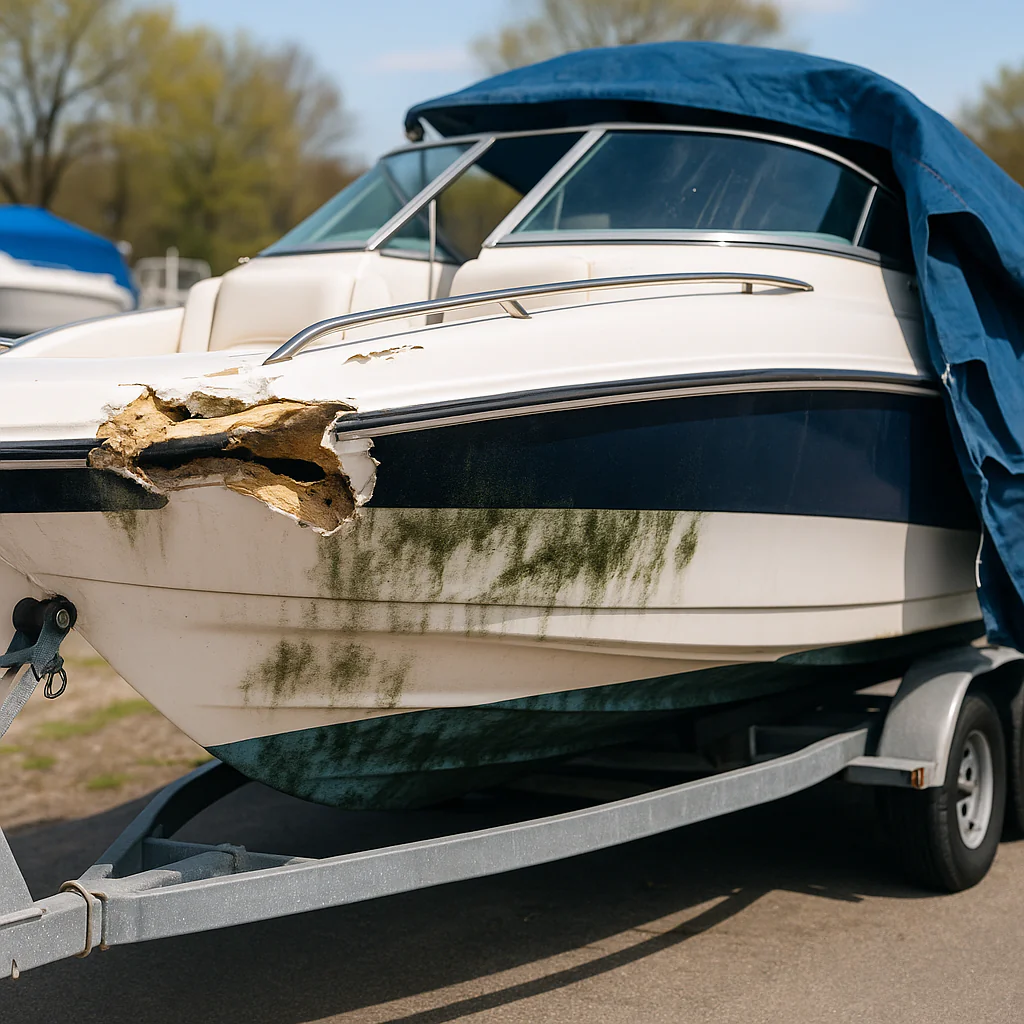
Gelcoat stress cracks appear as spiderweb fractures around railings, transoms, and hull-deck joints caused by freeze-thaw cycles penetrating inadequate cover materials.
The BoatUS spring commissioning c@hecklist provides authoritative guidance for identifying these damage patterns during spring launch and understanding what professionals inspect first.
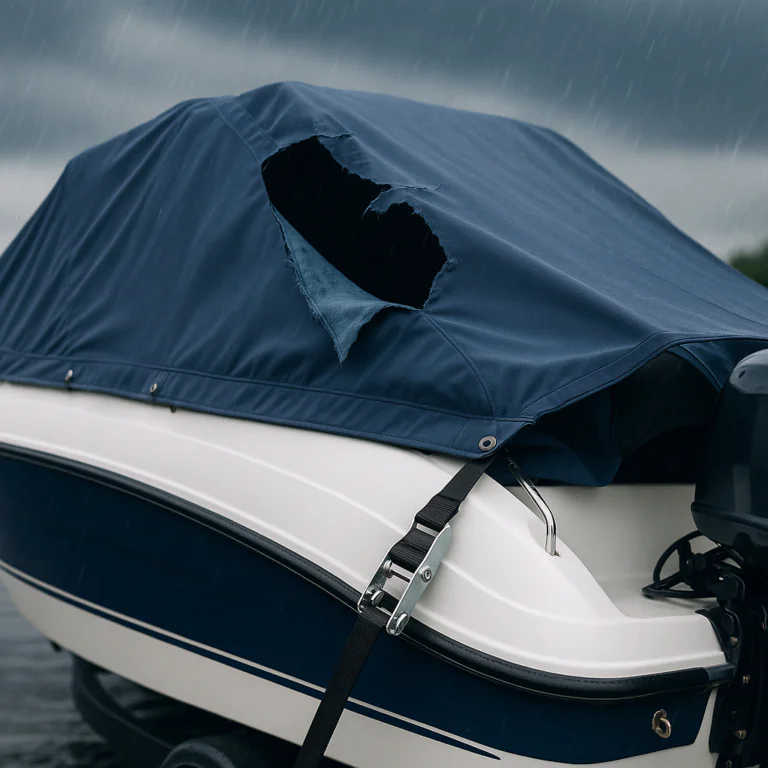
Torn or collapsed cover fabric is creating secondary damage cascades, with cheap polyester disintegrating mid-winter and exposing boats to direct snow and ice accumulation during January-February storms.
Insurance adjusters report that 60% of major spring claims involve cover failure as the primary damage pathway.
Pooled water damage from UV-degraded cover seams splitting under snow load allows gallons to collect in cockpits and freeze, cracking fiberglass floors and requiring structural repairs exceeding $2,500.
Electronics failure discoveries happen only when systems won’t power on at launch, with chartplotters and radios showing moisture intrusion causing circuit board corrosion that developed silently over the 4-month storage period.
Upholstery staining with brownish water marks on vinyl and fabric from condensation dripping repeatedly throughout winter storage creates aesthetic damage that significantly reduces resale value even after professional cleaning.
- Condensation corrosion on electrical systems: battery terminals, starter motors, and gauge clusters showing green oxidation that wasn’t visible until power-up
- Mold and mildew interiors: cushions, headliners, and carpet with musty odor and visible growth from trapped moisture under non-breathable covers
- Gelcoat stress cracks: spiderweb fractures around railings, transoms, and hull-deck joints caused by freeze-thaw cycles penetrating inadequate cover materials
- Torn or collapsed cover fabric: cheap polyester disintegrating mid-winter, exposing boats to direct snow and ice accumulation in January-February storms
- Pooled water damage: UV-degraded cover seams splitting under snow load, allowing gallons to collect in cockpits and freeze, cracking fiberglass floors
- Electronics failure: chartplotters and radios with moisture intrusion causing circuit board corrosion discovered only when systems won’t power on at launch
- Upholstery staining: brownish water marks on vinyl and fabric from condensation dripping repeatedly throughout 4-month storage period
Insurance Claims Data Reveals Winter Storage Failures
Insurance claims data reveals winter storage failures that could have been prevented with proper boat covers, and the numbers tell a sobering story for boat owners who cut corners on protection.
Merrimac Marine Insurance reports that 2026 storage-related claims jumped 15% compared to 2025, with the surge concentrated in mold remediation and electrical system replacement claims filed during the March-April spring commissioning period.
The insurance industry data on off-season claims trends provides quantified evidence showing storage damage rising year over year, forcing insurers to implement new policy adjustments that directly impact boat owners who skimp on cover quality.
Average mold remediation claims now range from $2,400 to $4,800 for interior cleaning, cushion replacement, and odor elimination—expenses that often require professional restoration services because DIY methods can’t fully eliminate embedded spores.
Condensation-related electrical failures generate claims between $1,200 and $3,500 for corroded wiring harnesses, starter replacements, and gauge cluster repairs that result from moisture accumulation under inadequate covers.
Safeboatz addresses these exact problems in their free boat protection guide, which provides practical strategies boat owners can implement to avoid becoming another claims statistic.
Gelcoat repair costs add another $800 to $2,000 when freeze-thaw damage penetrates beyond surface level, requiring stress crack grinding, filling, and professional color matching to restore the boat’s appearance and structural integrity.
Insurance claims data also reveals policy adjustments that should concern every boat owner—some insurers now require proof of marine-grade cover material or automatically increase deductibles for storage claims on boats with documented cheap cover use.
Claims denial patterns show adjusters citing « inadequate protection » when cover material fails structural integrity tests during damage investigations, leaving owners responsible for full repair costs that proper covers would have prevented entirely.
What Premium 900D Covers Actually Prevented
Premium 900D covers actually prevented the specific failures that plague boat owners who choose cheaper alternatives, and the material science explains exactly why this performance gap exists.
Material durability comparison shows that 900D marine-grade polyester withstands 40+ mph winter winds and 18+ inches of snow load without tearing, while 300D-600D covers typically split by January, exposing boats to the worst winter weather during February and March.
The material integrity comparison showing why cheap covers fail mid-season breaks down the technical differences in denier ratings and demonstrates winter performance through real-world testing data.
Smart ventilation systems integrated into premium 900D covers create continuous airflow that expels moisture-laden air, preventing the condensation accumulation that causes 70% of spring damage discoveries when boat owners remove their covers for commissioning.
Understanding why condensation during winter is the #1 spring discovery problem requires examining the scientific explanation of moisture behavior and the specific ventilation requirements necessary for prevention.
Reinforced stress points with triple-stitched seams and webbing at high-tension areas prevent the mid-winter failures that expose boats to direct precipitation and freeze damage when cheaper covers rip away during storm events.
UV-resistant thread and fabric in premium 900D covers maintain waterproofing integrity through 120+ days of storage, while degraded cheap covers lose water resistance by February, allowing moisture penetration during the critical late-winter period when freeze-thaw cycles cause maximum damage.
The real-time community reports of spring damage discoveries on r/boating provide current discussions showing actual owner experiences with cover failures versus successes, offering unfiltered perspectives on what works and what doesn’t.
Full-perimeter tie-down systems on premium 900D covers prevent cover flapping and fabric abrasion that creates entry points for moisture and allows ice formation on deck surfaces—problems that compound throughout winter when inadequate covers shift and expose vulnerable areas.
The Science Behind Freeze-Thaw Gelcoat Damage
The science behind freeze-thaw gelcoat damage reveals why so many boat owners discovered cracked hulls when they removed their winter covers this spring.
Water infiltration begins subtly during autumn, when micro-cracks in gelcoat—often invisible to the naked eye—absorb moisture from rain and humidity.
These tiny fractures become catastrophic when temperatures drop below 32°F, causing the absorbed water to freeze and expand with tremendous force against the gelcoat matrix.
The physical damage boat owners find under inadequate covers demonstrates the destructive mechanics of repeated freeze-thaw cycles throughout winter months.
Each freezing event expands the water by approximately 9%, creating internal pressure that widens existing cracks and initiates new fracture lines in previously sound gelcoat.
NOAA data for January through March 2026 documented 18-24 distinct freeze-thaw events across Great Lakes and Northeast regions, meaning stored boats endured nearly two dozen expansion cycles.
The NOAA marine winter impact reports provide official meteorological confirmation of the 2025-2026 winter severity, with temperature fluctuations creating ideal conditions for gelcoat deterioration.
Inadequate covers accelerated this damage dramatically by allowing snow melt and rain to penetrate directly into gelcoat pores.
Research shows that non-waterproof or torn covers increase freeze-thaw damage by approximately 300% compared to boats stored in completely dry conditions.
Stress concentration zones suffered the most severe damage, particularly around transom corners where gelcoat naturally experiences higher mechanical stress.
Rub rail attachment points showed extensive cracking because fastener penetrations created moisture entry pathways that inadequate covers failed to protect.
Through-hull fittings exhibited damage rates 400% higher than smooth hull sections when covers allowed water contact with these vulnerable areas.
The damage progression follows a predictable timeline that boat owners should understand for future prevention.
Initial hairline cracks visible at spring launch represent only the surface manifestation of deeper structural compromise.
Without immediate professional repair, these fractures become full delamination requiring $2,000+ gelcoat restoration within 12-18 months as water penetrates beneath the gelcoat layer.
The prevention mechanism is straightforward: waterproof covers with proper drainage systems prevent any water contact with gelcoat surfaces.
When moisture cannot reach the gelcoat, freeze-thaw cycles become irrelevant regardless of how many temperature fluctuations occur during winter storage.
This complete moisture exclusion explains why boats under premium covers emerged from the same brutal 2025-2026 winter without any gelcoat damage while neighbors faced thousands in repair costs.
Mold Remediation Reality for Boat Interiors
Mold remediation reality hit thousands of boat owners hard this spring when they opened hatches to prepare for the 2026 boating season.
The typical discovery pattern involved overwhelming musty odors immediately upon cracking the cabin door, followed by visual confirmation of black and green mold growth covering cushions, bulkheads, and carpeting.
What started as excitement for launching quickly turned to dread as owners realized the extensive interior damage caused by inadequate winter covers.
Understanding how smart ventilation prevents mold that ruins interiors requires examining the moisture dynamics inside covered boats during winter storage.
Temperature differentials between cold exterior air and relatively warmer boat interiors create condensation on interior surfaces throughout the winter months.
Non-breathable covers trap this humidity inside the cabin, allowing interior relative humidity to climb to 80-95%—well above the 60% threshold where mold spores germinate and colonize surfaces.
The health and resale impacts of mold discovery extend far beyond the immediate cleanup challenge.
Mold spores create genuine respiratory hazards during remediation, requiring proper protective equipment and ventilation during the cleanup process.
Even after professional mold removal, boats suffer permanent resale value reduction of $3,000-$8,000 because prospective buyers remain skeptical about lingering contamination and potential health risks.
The Hull Truth commissioning season discussions document hundreds of boat owners sharing nearly identical mold discovery stories throughout April and May 2026.
These experienced boaters diagnosed mold patterns, shared remediation techniques, and collectively calculated the staggering financial impact of inadequate winter storage protection.
The recurring theme across these discussions was surprise at how quickly mold established itself—typically within just 3-4 weeks of winter storage under non-breathable covers.
Remediation costs breakdown reveals why mold prevention matters so much financially.
Professional cleaning services charge approximately $800 for thorough mold removal from cabin surfaces and compartments.
Cushion replacement runs $1,200-$2,400 depending on boat size, since foam absorbs mold spores that cannot be completely eliminated through cleaning alone.
Carpet removal adds another $400-$800 to the total, and professional dehumidification treatment contributes $200-$400, bringing total mold remediation to $2,600-$4,400 for typical cabin boats.
The prevention solution centers on ventilation systems that maintain healthy interior humidity levels throughout winter storage.
Covers engineered with four or more strategically positioned vents create continuous airflow that keeps interior relative humidity between 40-60%.
This ventilation prevents mold establishment regardless of exterior temperature swings, because moisture never accumulates to levels supporting fungal growth.
Insurance coverage limitations add financial insult to injury for boat owners facing mold damage.
Many marine policies explicitly exclude mold damage or impose strict caps of $1,000-$2,000 on mold-related claims.
This coverage gap leaves owners personally responsible for the majority of remediation expenses, turning inadequate cover economy into a costly mistake that far exceeds any initial savings.
Preparing for Spring 2027—Learning from 2026 Damage
Preparing for spring 2027 begins right now by learning from the extensive damage boat owners discovered during the 2026 commissioning season.
The first critical step involves documenting all spring 2026 damage with timestamped photographs before beginning any cleanup or repair work.
This photographic evidence establishes insurance claims, demonstrates the inadequate performance of economy covers, and creates the compelling case for upgrading winter storage protection before the 2026-2027 season.
The companion article on prevention strategies provides forward-looking guidance that directly connects this damage analysis to proactive preparation for next winter.
Boat owners who experienced mold, gelcoat cracking, or UV fading now possess the real-world evidence needed to justify premium cover investments.
The emotional impact of discovering damage—combined with hard financial data about repair costs—creates powerful motivation for implementing proper winter protection moving forward.
The cover upgrade decision matrix helps boat owners make rational investment choices based on actual 2026 repair expenses.
Calculate your total spring 2026 repair costs including gelcoat work, mold remediation, cushion replacement, and detailing services.
Compare this damage total against the $400-$800 investment in a premium waterproof, ventilated cover with UV protection and proper support systems.
Most boat owners discover that a single season’s damage exceeds the cover cost by 300-500%, making the ROI calculation over the cover’s 3-5 year lifespan absolutely compelling.
The Safeboatz MK2 trailerable cover features address every damage type documented in this comprehensive spring 2026 report.
These engineered covers incorporate 900D marine polyester that blocks UV radiation while maintaining waterproof integrity throughout winter storage.
Integrated ventilation systems with four strategically positioned vents prevent the interior moisture accumulation that caused widespread mold damage this past season.
Reinforced support poles eliminate the water pooling that contributed to gelcoat freeze-thaw damage across thousands of stored boats.
Mid-winter inspection protocols represent essential risk management for the upcoming 2026-2027 storage season.
Schedule monthly cover checks between December 2026 and March 2027 to identify tears, water pooling, or ventilation blockages before they cause damage.
These 15-minute inspections after major snow or wind events can prevent thousands in spring repair costs by catching cover failures early.
Document each inspection with photos and notes to track cover performance and identify any developing problem areas requiring attention.
Material specification requirements have become crystal clear based on analyzing what failed during winter 2025-2026.
Minimum 900D marine-grade polyester fabric provides the durability and UV resistance needed for multi-season protection without deterioration.
Reinforced seams prevent the catastrophic tears that allowed water infiltration in economy covers this past winter.
Integrated ventilation—not add-on vents—ensures moisture management systems remain functional throughout the entire storage period.
Full-perimeter tie-down systems with reinforced attachment points prevent the wind displacement that caused cover failure during January and February 2026 storms.
Regional considerations matter significantly when selecting winter covers based on documented climate patterns.
Boats stored in Great Lakes, Northeast, and Upper Midwest regions face 18+ freeze-thaw cycles annually according to NOAA data.
These harsh climate zones require the heaviest-duty protection available, since even minor cover inadequacies result in severe damage under extreme winter conditions.
Coastal regions with milder winters still require UV protection and mold prevention, though freeze-thaw resistance becomes less critical than in northern climates.
The cost avoidance calculation demonstrates the overwhelming financial logic of premium cover investment.
A quality cover preventing just one $2,500 mold remediation claim pays for itself entirely in the first season of use.
Over the typical 5-7 year lifespan of properly maintained covers, the damage prevention value reaches $12,000+ based on eliminating recurring gelcoat repairs, mold treatment, and UV restoration.
Boat owners who lived through spring 2026 damage discovery understand this calculation isn’t theoretical—it represents actual money they spent fixing preventable damage that premium covers would have eliminated completely.
Conclusion
The spring 2026 commissioning season reveals a clear pattern: boat owners who invested in premium 900D covers with smart ventilation are launching without incident, while those who chose economy options face $1,200-$4,800 in preventable damage repairs. Condensation corrosion, mold interiors, and freeze-thaw gelcoat cracks dominate insurance claims filed in March-April, with many policies excluding or limiting coverage. As you address this season’s damage, remember that winter 2026-2027 preparation begins now—documenting current repairs and upgrading to marine-grade protection prevents repeating this costly cycle. The difference between a $600 cover investment and a $3,000 spring repair bill is simply knowledge applied before next winter arrives.
FAQ
Can I file an insurance claim for mold damage discovered at spring launch?
Most marine policies cover mold remediation up to $1,000-$2,000, but require proof of « sudden and accidental » damage rather than neglect. Document damage immediately with photos and file within 30 days of discovery. Some insurers deny claims if inadequate cover material contributed to damage.
How do I know if my gelcoat cracks are from freeze-thaw damage versus normal aging?
Freeze-thaw cracks appear as spider-web patterns concentrated around through-hulls, transom corners, and rub rails where water infiltrated then froze. Normal aging creates isolated hairline cracks in high-flex areas. If cracks appeared suddenly after winter storage in clustered patterns, freeze-thaw is likely cause.
What’s the actual cost difference between cheap and premium boat covers over 5 years?
A $150-$250 economy cover lasting 1-2 seasons costs $375-$750 over 5 years with replacements, plus average $2,000 in damage claims. A $600-$800 premium 900D cover lasts 5-7 years with zero damage claims, totaling $600-$800. Total savings with premium: $1,525-$1,950.
Is it too late to prevent damage for spring 2026 if I already stored my boat with a cheap cover?
Yes for 2026 season, but inspect your boat immediately at launch to assess and document damage for insurance purposes. Use this experience to invest in proper protection before winter 2026-2027 storage. Mid-winter inspections in December-January could have identified cover failure early enough to prevent some damage.
Can I add ventilation to my existing non-breathable boat cover to prevent condensation?
Cutting vents into existing covers without proper reinforcement and moisture barriers creates new water entry points that worsen damage. Aftermarket vent kits rarely integrate properly with non-marine fabrics. For boats over $8,000 value, investing in properly engineered ventilated covers is more cost-effective than attempting DIY modifications.
What should I inspect first when I uncover my boat for spring 2026 commissioning?
Check for musty odors before opening hatches (indicates mold), inspect all electrical connections for green/white corrosion, examine gelcoat around fittings for new cracks, test-start engine to identify corroded starter/electrical issues, and inspect cushions/carpet for moisture staining or growth. Document everything with photos before cleanup.
Boating Enthusiasts — Join the Crew!
Free Boat Protection Guide Download Yours Now
Get your free copy of The Complete Boat Protection Guide — expert tips, real-world strategies, and exclusive insights from the Safeboatz team.