 SafeBOT

Fishing Boat Cover Guide: Fit, Trolling Motors & Trailering Checks
Choose a fishing boat cover with fewer fit surprises. Learn how to measure length and beam, allow for trolling motors and consoles, and check the setup before trailering.

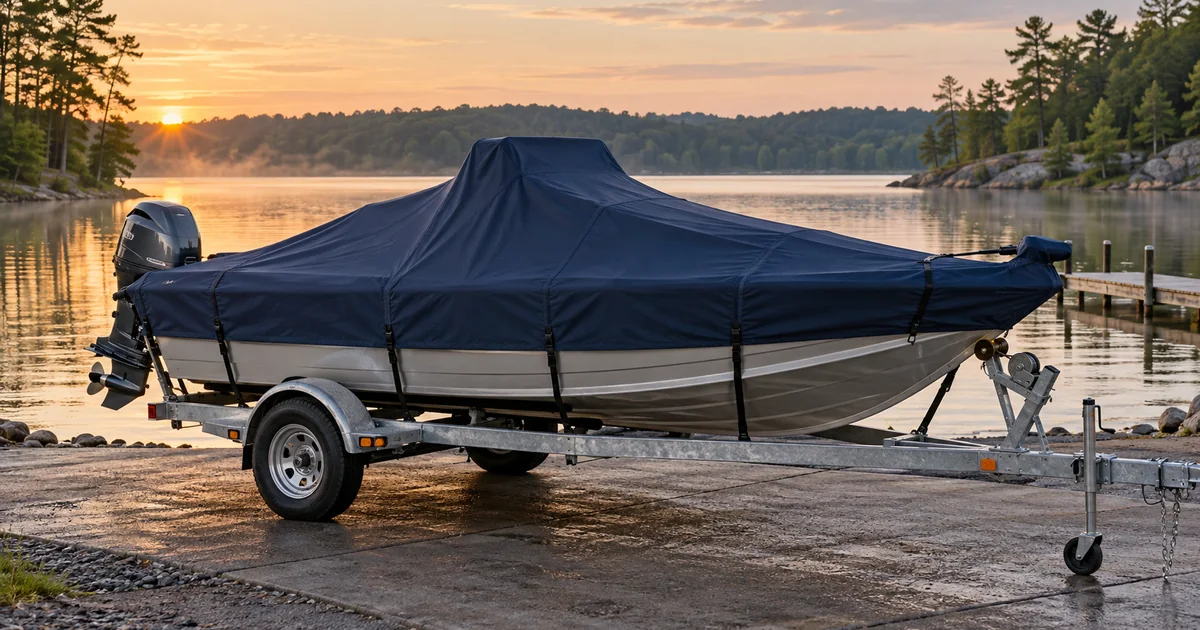
A fishing boat cover has to fit more than a hull. Consoles, windshields, bow-mounted trolling motors, rails, folded biminis, and an outboard can change the shape the cover must clear. Measure the boat in its normal covered configuration, then check how the cover will be supported and secured. That is more useful than choosing by the boat’s model name alone.
This guide does not match a cover to a specific boat. Boats with the same listed length can have different layouts and measurements.
The short answer: how to choose a fishing boat cover
Start with the boat’s centerline length and maximum beam, measured rather than estimated. Then account for every fixed or folded feature that will sit under or beside the cover. Confirm that the cover is intended for your planned use, especially if you expect to tow with it installed. A workable setup also needs a clear runoff shape, secure tie-down points, and no concentrated pressure on sharp hardware.
- Measure centerline length without following the curve of the deck.
- Measure the widest point of the boat for beam.
- List everything that changes the covered profile.
- Plan support so water cannot settle in broad low spots.
- Plan strap routing to the trailer frame before towing.
- Recheck the complete setup after a short shakedown drive.
For a detailed measuring sequence, use our boat cover measuring guide before comparing size ranges.
Measure the boat you actually cover
The number printed on a boat registration, brochure, or model badge may not describe the span a cover must handle. A bow pulpit, swim platform, bracket, or permanently mounted accessory can change the relevant length. The cover also has to travel over the boat’s vertical profile, so two hulls with similar length and beam may not use fabric in the same way.
Centerline length
Measure in a straight line along the boat’s centerline, from the forwardmost point that needs coverage to the aft end of the covered area. Do not run the tape down and around the windshield or follow the gunwale. Note separately whether platforms, brackets, or other projections are included. This gives you a clean base measurement without hiding the effect of accessories.
Maximum beam
Measure the boat at its widest point. Do not assume the beam at the windshield, console, or stern is the maximum. On a trailer, make sure the tape stays level enough to give a useful straight measurement. A cover that is already tight across the beam has less room to rise over a console or seat.
Covered height and profile
Length and beam narrow the search, but profile explains many fit problems. Sketch a side view if the boat has a tall windshield, raised casting seats, rails, or a folded top. You are not trying to calculate fabric area. You are spotting high points, sharp transitions, and equipment that may pull the hem upward or prevent even tension.
Account for the trolling motor before choosing a size
A bow-mounted trolling motor is one of the easiest details to overlook. In the stowed position, its mount, shaft, head, wiring, and prop area may extend above or outside the bow profile. A cover should not be forced over that assembly simply because its stated length range matches the hull.
- Stow the motor exactly as it will sit under the cover.
- Turn or position the motor head as recommended for storage.
- Keep loose wiring and plugs from becoming pinch points.
- Look for sharp corners or protruding hardware that could concentrate pressure.
- Check whether the motor causes the cover hem to lift away from its intended position.
Do not solve a tight spot by pulling harder on the straps. Excess tension can transfer the problem to the fabric, seams, mount, or nearby hardware. If the trolling motor keeps the cover from sitting naturally, stop and reassess the size, shape, or covered configuration. Removing an accessory is only an option when its manufacturer’s instructions and your normal setup make that practical.
Check consoles, windshields, rails, and the folded bimini
A replacement windshield, electronics mount, grab rail, rod holder, or seat can change a cover fit that once looked simple. Inspect the full profile before measuring.
Console and windshield
Check the top edge and corners of the windshield, then look at the electronics and mounts nearby. The fabric should cross the area without resting hard on one small edge. Where the cover maker permits it, smooth protective padding can reduce abrasion at unavoidable contact points. Padding is not a substitute for a cover that has enough room for the console.
Rails and deck hardware
Bow rails, cleats, antenna bases, rod holders, and light sockets deserve a hand check. Feel for burrs, corners, and upright fittings before pulling the cover into place. Remove loose equipment. Lower or stow movable items according to their instructions.
Folded bimini
A folded bimini can add a long raised section rather than one isolated high point. Secure it in its proper travel or storage position and include it in your profile check. Watch the hinges, frame ends, and bundled fabric. If the folded top changes where the cover hem lands, the nominal hull size alone is not enough to judge fit.
Outboard clearance
Confirm where the cover is meant to finish around the stern and how the outboard affects that path. Measure and inspect with the motor in the position you plan to use for storage or towing. Do not assume the main boat cover includes or fully encloses the outboard unless the product description says so. Keep cables, controls, and fittings free from awkward pressure.
Build a shape that sheds water
A cover can match the perimeter and still perform poorly if the middle sags. Broad, flat areas between the windshield, seats, and gunwales can collect rain. The goal is a stable slope from supported high points toward the sides, without stretching the cover over a sharp peak.
Use supports that are suitable for your cover and boat layout, and position them where the structure below can safely carry the load. Test the shape from the bow, stern, and both sides. If you can see a basin, water can find it. Our guide to boat cover support poles and water pooling explains how to diagnose low spots before they become a recurring problem.
Support and tension work together. Too little tension lets fabric move and sag. Too much can overload contact points and distort the cover. Aim for an even, intentional shape rather than trying to make every panel drum-tight.
Set the straps before the highway
Trailering changes the job. Airflow can work under a loose edge, and a strap that looked clear in the driveway can rub against a painted surface or shift near a tire. First confirm that the cover is designed for trailering. Then install it according to its instructions and secure the tie-downs to appropriate points on the trailer frame.
- Center and seat the cover before tightening individual straps.
- Route each strap without twists and away from sharp edges, wiring, brake lines, moving parts, and hot components.
- Keep straps clear of tires, hubs, suspension parts, and the road.
- Tension the system progressively, moving around the boat instead of fully tightening one corner first.
- Secure loose strap ends so they cannot whip against the hull.
- Inspect the hem, stern area, bow, and every high point.
The boat cover straps and tie-down guide covers routing and tension in more detail. For the complete sequence at the ramp, driveway, or storage area, follow the boat cover installation guide.
Run a pre-trailering cover check
Do the final walkaround after the boat is hitched and loaded as it will travel. A cooler, seat, battery box, or other item moved at the last minute can change the covered profile. Nothing loose should remain where it can shift under the fabric.
- The cover is identified by its maker as suitable for trailering.
- The bow and stern are oriented correctly.
- The hem sits where intended around the boat.
- No strap is twisted, dangling, or crossing a vulnerable surface.
- The trolling motor and folded bimini are secured in their proper positions.
- The cover is clear of sharp or hot components.
- Support pieces are stable and approved for the planned use.
- All loose equipment has been removed or secured.
Start with a short, low-speed shakedown drive in a safe area. Stop and inspect the cover, straps, support points, and contact areas. Check again after the first few miles and during normal travel stops. If the cover shifts, balloons, loosens, or begins to rub, correct the setup before continuing. Weather and road conditions can change how the system behaves, so yesterday’s strap position is not a substitute for today’s inspection.
Common fishing boat cover fit mistakes
- Buying from the model name alone. Packages and owner-added equipment can change the profile.
- Measuring only the hull. The widest and highest parts may be accessories, not the bare hull.
- Ignoring the trolling motor. A stowed bow motor can create both height and width conflicts.
- Using strap tension to hide a bad fit. More force does not create missing clearance.
- Leaving a flat span unsupported. A shallow-looking depression can become a pooling point.
- Towing without a shakedown stop. The first short drive often reveals movement that was not visible while parked.
Compare current Storm Series size ranges
Safeboatz currently lists two Storm Series trailerable motorboat cover size ranges: 17–19 ft and 20–22 ft. These ranges are a starting point, not a fit claim for a particular fishing boat. Compare your measured centerline length and maximum beam with the current product-page guidance, then account for the console, windshield, trolling motor, rails, folded bimini, outboard, and any other equipment in the covered profile.
If a measurement sits near a limit, or an accessory changes the profile substantially, pause before ordering. A few minutes spent checking the complete configuration is better than trying to make a marginal fit work with extra strap tension.
Fishing boat cover FAQ
How do I measure a fishing boat for a cover?
Measure the straight centerline length of the area that needs coverage and the boat’s maximum beam. Then record the height and position of the console, windshield, bow-mounted trolling motor, rails, folded bimini, outboard, and other fixed equipment. Use the product maker’s sizing directions to compare those measurements.
Can a fishing boat cover go over a bow-mounted trolling motor?
Only if the cover has enough room in the motor’s properly stowed position and the product guidance supports that configuration. Check the mount, shaft, head, wiring, prop area, and nearby sharp edges. Do not force the cover over the motor or use extra strap tension to overcome poor clearance.
Should I include the outboard in my boat-length measurement?
Follow the cover maker’s measurement instructions. Main boat covers differ in where they end at the stern and whether an outboard is enclosed. Record the outboard position and any bracket or platform separately so you can compare the actual setup with the product description.
Can I trailer my fishing boat with the cover installed?
Trailer with a cover only when the cover is intended for that use and installed according to its instructions. Route tie-downs to suitable trailer-frame points, keep them away from tires and sharp or hot parts, secure loose ends, and make a short shakedown drive followed by an inspection.
How tight should a trailerable fishing boat cover be?
It should sit evenly and securely without loose areas that can catch air, but it should not be forced over high points or tightened until the fabric and hardware are under concentrated strain. Tension the straps gradually around the boat, following the cover maker’s instructions, and recheck after a short drive.
Measure first, then compare the cover
Write down the centerline length, maximum beam, and every part of the covered profile. With those numbers in hand, compare the current Storm Series options and choose only after the full setup makes sense for your boat and planned use.
Boating Enthusiasts — Join the Crew!
Free Boat Protection Guide Download Yours Now
Get your free copy of The Complete Boat Protection Guide — expert tips, real-world strategies, and exclusive insights from the Safeboatz team.