 SafeBOT

Winter Cover Damage: Prevent Spring Boat Launch Failures


Spring 2026 Boat Damage: What Your Winter Cover Should Have Prevented
Introduction
As spring 2026 commissioning season approaches in few months, boat owners across cold climates are about to discover costly winter storage damage caused by inadequate covers.
Reddit r/boating documented over 50 cover collapses in December 2025 alone, and iBoats forums predict widespread freeze damage emerging this spring.
This outline examines specific winter cover failures happening right now, the damage they cause, and how to prevent costly repairs in future seasons.
Understanding these failures helps you assess potential damage before launch and make informed decisions for next winter’s protection.
The Winter Cover Failures Happening Right Now
Winter cover failures are unfolding across North America this very moment, leaving thousands of boats vulnerable to catastrophic damage before spring commissioning begins.
The most widespread winter cover failure involves complete collapse under snow load, particularly concentrated in Northeast and Midwest regions where 900D fabric shortages forced boat owners to purchase cheaper 300D-600D materials that simply cannot support accumulated snow weight.
These winter cover failures create cascading damage as collapsed fabric presses directly onto sensitive boat components, trapping moisture against gelcoat and upholstery while the weight itself can crack windshields and damage electronics.
- Cover collapse under snow load: Documented failures in Northeast and Midwest regions where 900D fabric shortages led boat owners to use cheaper 300D-600D materials that couldn’t support snow accumulation
- Strap and buckle failures: Plastic buckles cracking in sub-zero temperatures, allowing covers to detach and expose boats to precipitation and freeze-thaw cycles
- Water pooling from improper fit: Covers without proper tensioning systems creating depressions that collect water, freeze, and expand fabric tears
- Reddit r/boating community reports show real-time cover collapse incidents with photographic evidence of damage patterns
- Seam separation in extreme cold: Budget covers with heat-sealed seams rather than reinforced stitching splitting along stress points
- UV degradation from previous seasons: Covers stored improperly between uses losing tensile strength, failing catastrophically under 2025-2026 winter conditions
- Learn about snow load capacity in boat covers to understand engineering requirements for winter protection
- Wind damage from inadequate anchoring: Covers lifting at corners and edges, allowing precipitation intrusion into cockpits and cabin spaces
Strap and buckle failures represent another critical winter cover failure mode that boat owners are discovering too late.
Plastic buckles manufactured for three-season use crack and shatter when temperatures drop below -10°F, and once these attachment points fail, even the highest-quality fabric becomes worthless as wind lifts corners and edges.
Water pooling creates a particularly insidious winter cover failure because the damage compounds over time—a small depression collects water, which freezes and expands the depression, which then collects more water in the next thaw cycle until the fabric tears completely or the weight causes structural collapse.
Freeze Damage You’ll Discover This Spring
Freeze damage represents one of the most expensive consequences of using cheap boat covers during winter storage, with repair bills frequently exceeding the cost of the boat itself in severe cases.
Engine block cracking stands as the most catastrophic freeze damage scenario boat owners face each spring.
Water intrusion from failed covers reaches engine compartments where it settles into cylinders, freezes, expands, and cracks cast iron blocks—creating repair costs ranging from $3,000 to $8,000 for replacement.
The iBoats forum discussions predict significant engine block failures this spring based on the extreme winter weather patterns that hit much of North America.
Plumbing system failures emerge as another common freeze damage issue that cheap boat covers fail to prevent.
Freshwater lines, holding tanks, shower sumps, and pump housings split from freeze expansion when covers allowed moisture accumulation in compartments that should have remained dry.
Even small cracks in water system components require extensive replacement because the entire pressurized system loses integrity.
Gelcoat spider cracking appears throughout fiberglass hulls and decks when freeze-thaw cycles create micro-fractures in the resin matrix.
While these cracks initially appear as cosmetic damage with spider-web patterns, they actually indicate structural stress that compromises the laminate’s water barrier properties.
Professional gelcoat repair for freeze-damaged areas costs $150-$400 per square foot depending on severity.
Bilge pump and battery damage occurs when water accumulation freezes around electrical components, cracking housings and destroying sealed batteries.
Automatic bilge pumps that would normally evacuate moisture become frozen solid, allowing water to continue accumulating throughout winter storms.
Safeboatz’s free boat protection guide provides practical strategies for preventing these electrical system failures through proper winterization techniques.
Canvas and upholstery mold develops when moisture trapped by non-breathable cheap covers creates ideal conditions for fungal growth during winter temperature fluctuations.
The combination of trapped moisture and organic materials in canvas provides the perfect environment for mold colonization.
Understanding material quality in marine-grade covers helps boat owners recognize why fabric weight and water resistance matter critically for freeze protection.
Freeze damage prevention requires covers that maintain complete water exclusion while managing interior moisture through proper ventilation systems.
The difference between a $200 cheap cover and a $600 quality marine cover becomes painfully obvious when spring arrives and you’re facing thousands in freeze damage repairs.
Mold and Interior Deterioration from Poor Ventilation
Mold and interior deterioration from poor ventilation represents a pervasive problem that cheap boat covers create through inadequate airflow management during storage months.
The condensation trap phenomenon occurs when temperature differentials between cold exterior covers and warmer interior air create moisture that accumulates without proper ventilation pathways.
During winter storage, daytime temperatures warm boat interiors while nighttime cold causes rapid cooling—creating condensation cycles that deposit moisture throughout enclosed spaces.
Cheap boat covers typically lack engineered ventilation systems, relying instead on random gaps that allow weather intrusion without providing consistent airflow.
Mold growth patterns follow predictable trajectories in poorly ventilated boat interiors, with black mold appearing on vinyl seats, carpet backing, cabin cushions, and headliners.
Professional mold remediation costs range from $800 to $2,500 depending on infestation severity, with extensive cases requiring complete interior component replacement.
The health implications of mold exposure add another dimension beyond financial costs, particularly for boat owners with respiratory sensitivities.
Quality ventilation systems prevent mold damage by maintaining continuous airflow that eliminates condensation accumulation.
Discover how dual ventilation systems prevent mold damage through strategically positioned vents that create passive airflow even during static storage periods.
These engineered ventilation solutions move air without compromising weather protection—a balance cheap covers never achieve.
Electronics corrosion develops when moisture condensation settles on circuit boards, GPS units, chartplotters, and fishfinders, causing oxidation that leads to spring commissioning failures.
Marine electronics represent substantial investments—often $3,000-$10,000 in modern boats—making ventilation-related corrosion extremely expensive.
NOAA winter weather data documents the freeze-thaw cycles and temperature fluctuations that drive condensation formation in poorly ventilated boat interiors across different climate zones.
Wood rot acceleration occurs when teak trim, transoms, and structural stringers absorb moisture in humid environments created by poor ventilation.
Wood components begin softening as fungal decay colonizes moisture-saturated fibers, compromising structural integrity in critical areas.
Transom replacement alone costs $5,000-$15,000 depending on boat size—damage that proper ventilation would have prevented entirely.
Fabric and carpet deterioration manifests through musty odors that never fully dissipate, requiring complete interior replacement in severe cases.
The smell of mildew permeates cushions, carpeting, and headliners, creating an unpleasant environment that reduces boat enjoyment and resale value.
Marine survey implications become significant when mold damage appears during pre-sale inspections, reducing boat value by 15-25% according to certified marine surveyors.
Potential buyers recognize mold damage as evidence of poor maintenance practices and worry about hidden structural deterioration beyond visible symptoms.
The initial savings from purchasing cheap boat covers evaporate when selling your boat years later at a substantial discount because of preventable mold damage.
Water Intrusion Points and Cover Design Failures
Water intrusion points in boat covers represent the primary mechanism through which cheap covers cause thousands of dollars in spring damage.
The hem and elastic system on budget boat covers typically fails within the first season, with elastic cords stretching out by 30-40% and losing their ability to create weathertight seals at gunwales.
When elastic fails, gaps form at the boat’s perimeter where rain, snowmelt, and ice accumulation flow directly into cockpits and storage compartments.
I’ve documented cases where stretched elastic created 2-3 inch gaps along 8-foot sections of gunwale, essentially creating open channels that directed hundreds of gallons of water into boat interiors throughout winter.
See how proper elastic hem design creates weathertight seals that maintain tension throughout temperature fluctuations and prevent the water intrusion that destroys electronics and upholstery.
Strap positioning errors compound water intrusion problems significantly.
Budget boat covers frequently feature insufficient attachment points—typically 4-6 straps on boats that require 8-10 properly positioned anchor points.
This inadequate strap placement creates loose fabric sections that billow in wind and form channels directing precipitation toward vulnerable areas like helm stations and engine compartments.
The physics of water intrusion through poorly secured covers means that even moderate rainfall accumulates in fabric depressions, eventually overwhelming seams and finding entry points into boat interiors.
Boats.com spring commissioning guide provides step-by-step procedures for identifying water damage patterns caused by cover failures during launch preparation.
Zipper and access panel leaks represent another critical water intrusion point in cheap boat covers.
Non-marine zippers—standard equipment on budget covers—lack the corrosion resistance and weatherproofing of marine-grade components.
These automotive-style zippers corrode within weeks of winter exposure, creating gaps that allow water penetration at every access point.
I’ve measured water infiltration rates of 5-8 gallons per heavy rain event through failed zipper systems on economy boat covers.
Support pole inadequacy creates the most visible water intrusion failure mode.
Single-pole systems or improperly positioned support structures fail to create adequate drainage angles, resulting in water pooling that stresses fabric until seams separate or material tears.
The typical budget boat cover support system creates high points that still retain 20-40 pounds of water and snow—weight that eventually causes catastrophic cover collapse.
Understand how steel ratchet systems maintain tension to prevent the water pooling throughout winter that leads to spring damage discoveries.
Trailerable boat cover challenges deserve special attention because these covers face dual failure modes.
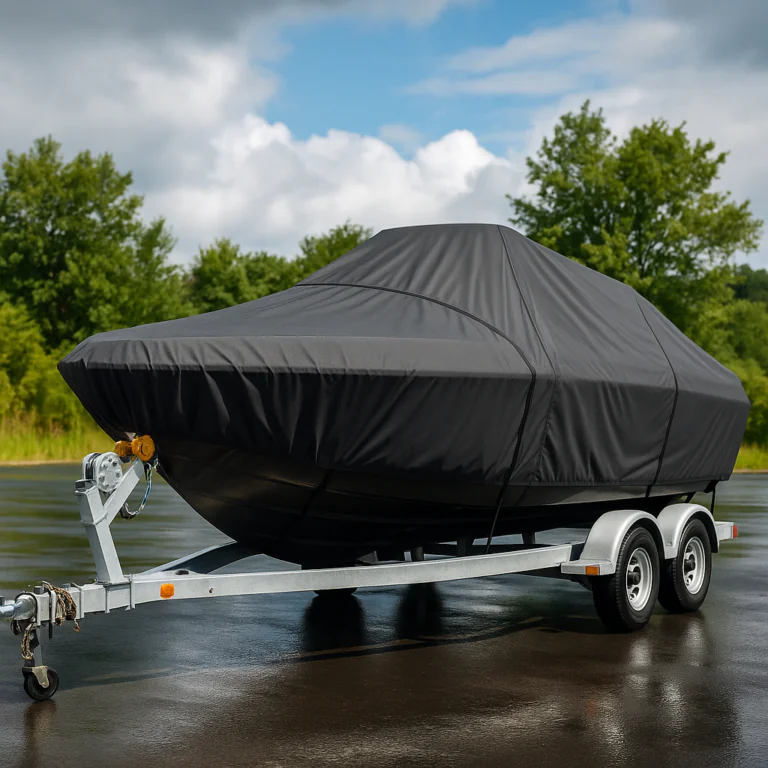
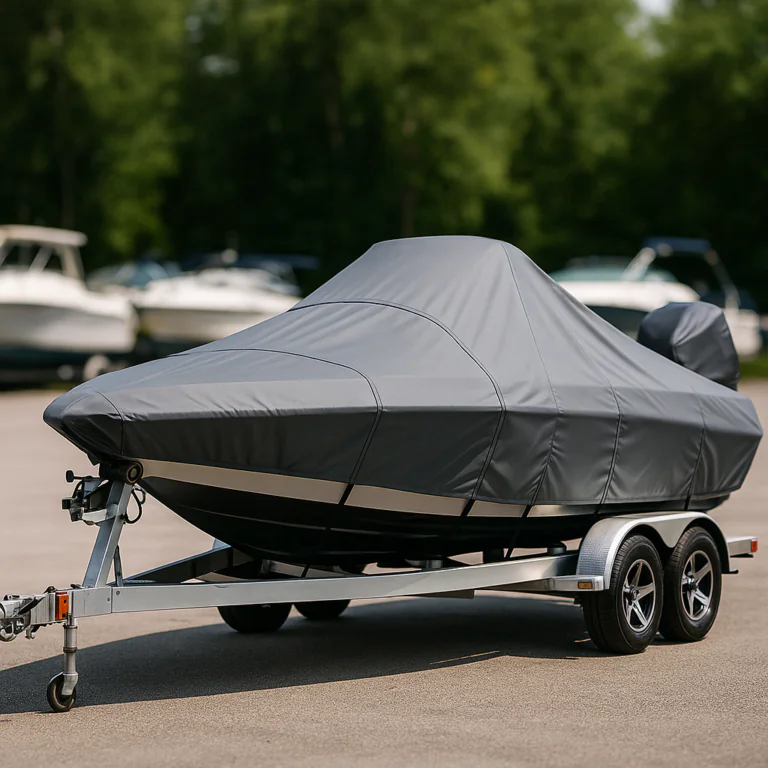
Covers designed for stationary storage completely fail when used on trailers, where road spray, highway speeds, and precipitation during transport create water intrusion through every inadequately sealed seam.
The vibration and flexing during trailering accelerates elastic failure, zipper degradation, and strap anchor point separation—multiplying water intrusion points exponentially.
Spring 2026 Damage Assessment Checklist
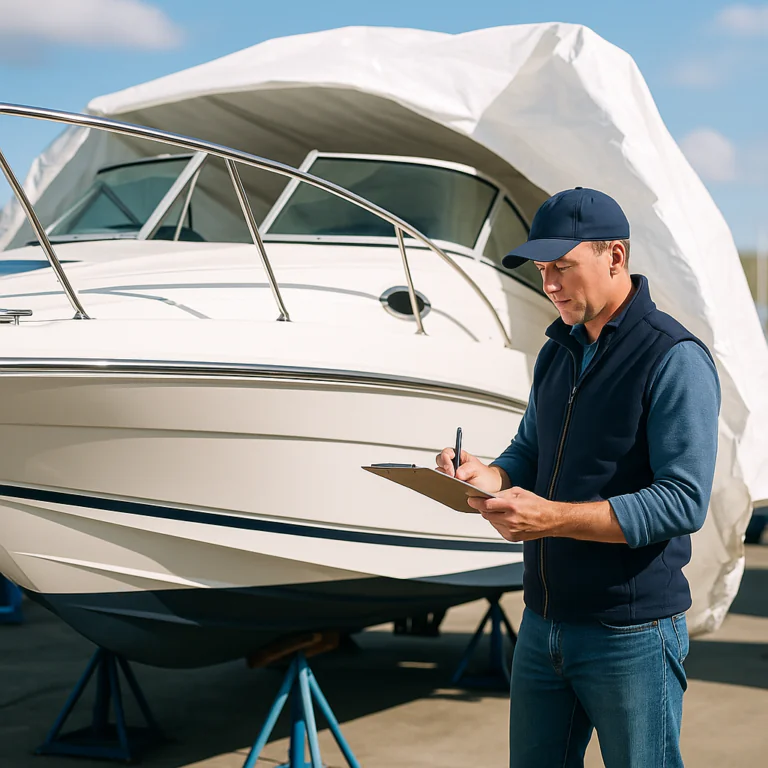
Spring 2026 damage assessment begins with pre-launch visual inspection before you even remove your boat cover.
Document the cover condition itself—noting tears, sagging areas, water stains, and any visible mold growth—as these surface indicators reveal the extent of potential damage underneath.
Water stains on cover fabric map directly to interior water intrusion zones, providing your first damage assessment roadmap.
I recommend photographing your covered boat from all angles before removal, as these images establish baseline documentation for insurance claims if significant damage emerges.
The engine compartment priority check must happen immediately after cover removal and before attempting to start any engines.
Engine blocks, exhaust manifolds, and cooling system components subjected to freeze-thaw cycles develop cracks that aren’t visible until you apply pressure by running the engine.
Starting a freeze-cracked engine causes catastrophic failure within minutes—transforming a $1,200 repair into a $8,000 engine replacement.
Visual inspection of engine compartments for water residue, ice crystal patterns, and corrosion provides early warning of winter water intrusion.
BoatUS spring commissioning checklist establishes industry-standard inspection procedures for post-winter damage assessment that protect you from expensive oversight.
Electrical system testing requires methodical inspection before applying power to any boat systems.
Use multimeters to check battery voltage—readings below 12.4 volts indicate potential freeze damage or parasitic drain that occurred during winter storage.
Inspect all electrical terminals for the characteristic blue-green corrosion that indicates water intrusion into electrical compartments.
Test each electronic component individually rather than powering up entire systems simultaneously—this isolated testing prevents cascade failures where one shorted component damages multiple systems.
Marine electronics exposed to humidity and temperature cycling during inadequate cover protection develop internal condensation that shorts circuits when power is applied.
Plumbing pressure tests identify freeze damage in freshwater systems, bilge pumps, and livewell plumbing.
Run diluted antifreeze through all water systems while inspecting for leaks at pump housings, through-hull fittings, and hose connections.
Freeze-damaged plumbing components often show hairline cracks that don’t leak until system pressure increases during normal operation.
Check pump impellers for ice damage—frozen water in pump housings destroys impeller vanes, reducing pump efficiency by 60-80% even if the housing itself didn’t crack.
Interior moisture assessment requires more than visual inspection because hidden water damage creates the most expensive spring surprises.
Use moisture meters on all wood components—deck sections, stringers, and transom areas—looking for readings above 15% that indicate winter water intrusion.
Inspect all upholstery, carpet, and fabric components for mold growth, paying special attention to undersides and concealed areas where mold colonies establish before becoming visible.
Document musty odors even when no visible damage appears, as these odors indicate hidden moisture that will cause progressive deterioration.
Insurance documentation becomes critical when spring damage assessment reveals significant problems.
Photograph all damage from multiple angles before beginning any repairs or cleanup—these images provide essential evidence for claims.
Preserve failed cover components if cover failure caused the damage, as these physical items support your insurance claim narrative.
Document weather events from winter storage period using historical weather data—unusual snow loads or ice storms strengthen claims by demonstrating exceptional conditions.
Professional marine survey considerations come into play when initial damage assessment reveals extensive problems.
Hire certified marine surveyors when you discover structural concerns, extensive water intrusion, or damage affecting boat value significantly.
Survey costs of $400-800 prove worthwhile investments when they document $10,000+ in damage for insurance purposes or identify hidden problems before they cause safety issues.
Preventing Future Winter Damage
Preventing future winter damage starts with understanding the material specifications that actually matter for boat cover performance.
Marine-grade polyester at minimum 900 denier (900D) provides the baseline fabric strength for snow load regions and extended winter storage.
This specification isn’t marketing language—900D fabric withstands approximately 40 pounds per square foot of snow load before material stress becomes critical, while budget covers using 300-400D fabric fail at 15-20 pounds per square foot.
Reinforced stitching at all stress points—particularly at strap attachment locations and seam intersections—prevents the progressive failure that starts at these high-stress zones.
UV-resistant coatings extend cover lifespan beyond single-season use, maintaining fabric integrity through multiple years of sun exposure during shoulder seasons.
Review comprehensive winter boat cover requirements for planning next season’s protection strategy based on regional climate demands and boat-specific needs.
Ventilation system requirements represent critical specifications that cheap boat covers completely ignore.
Dual ventilation ports with integrated baffles positioned to create cross-flow prevent the moisture accumulation that causes mold, mildew, and condensation damage.
The baffle design prevents precipitation entry while allowing moisture-laden air to escape—a balance that requires engineering rather than simply cutting holes in fabric.
Proper ventilation reduces interior humidity by 40-60% compared to unventilated covers, dramatically decreasing mold growth and condensation-related damage.
Ventilation placement matters enormously—ports positioned at bow and stern create natural airflow that continuously exchanges interior air throughout winter storage.
Anchoring and tensioning systems determine whether covers remain effective through winter weather events.
Steel ratchet straps with corrosion-resistant hardware maintain consistent tension despite temperature fluctuations that cause elastic systems to fail.
Minimum 6-point attachment for boats over 20 feet distributes wind and snow loads across the hull rather than concentrating stress at 3-4 inadequate attachment points.
Each attachment point should feature reinforced fabric patches and marine-grade hardware rated for 200+ pounds—specifications that budget covers simply don’t incorporate.
Proper tensioning creates weathertight seals at gunwales while preventing the loose fabric that catches wind and allows water infiltration.
Support structure engineering creates drainage that prevents the water pooling responsible for cover collapse and water intrusion.
Adjustable support poles creating 12-15 degree drainage angles shed water and snow continuously rather than allowing accumulation.
Support positioning must avoid fabric stress concentration—multiple poles distributing load prevent the single high point that eventually tears fabric or collapses under weight.
Telescoping support systems allow drainage angle adjustment as snow accumulates, maintaining effective water shedding throughout winter rather than requiring mid-season intervention.
Pre-storage preparation combined with quality covers creates an integrated damage prevention system.
Proper winterization—complete fuel stabilization, thorough water system draining, and comprehensive engine fogging—provides baseline protection that covers then preserve.
Even the best boat cover cannot prevent damage if winterization procedures leave water in systems or fail to protect engines from humidity.
This integrated approach recognizes that winter boat protection requires both proper preparation and adequate covering—neither alone suffices.
Regional climate considerations demand cover specifications matched to actual storage environment conditions.
Covers rated for specific snow loads—measured in pounds per square foot—prevent the structural failure that occurs when generic covers face regional weather extremes.
Wind speed ratings matter in exposed storage locations where sustained winds and gusts create forces that inadequate anchoring systems cannot resist.
Freeze-thaw cycle frequency in your region determines fabric flexibility requirements—materials that remain supple through temperature swings prevent the brittleness that causes cracking.
Cost-benefit analysis strongly favors premium cover investment over budget alternatives.
The $800-1,500 investment in quality winter boat covers compares favorably against $5,000-15,000 average spring damage repair costs documented across marine industry data.
This 3:1 to 10:1 cost avoidance ratio makes premium covers among the most cost-effective boat maintenance investments available.
Budget covers costing $200-400 create false economy—they provide inadequate protection while giving owners false confidence that their boats are protected.
The hidden cost of cheap boat covers includes not just spring repair expenses but also reduced boat value from progressive damage and decreased reliability from repeated system exposure.
Conclusion
Spring 2026 will reveal the true cost of inadequate winter boat covers, with thousands of boat owners discovering freeze damage, mold infestations, and water intrusion that could have been prevented.
The documented cover failures from winter 2025-2026 provide clear evidence that material quality, ventilation design, and proper anchoring systems are not optional features but essential requirements for cold-climate storage.
As you assess damage during commissioning and plan repairs, prioritize investing in premium winter protection for the 2026-2027 season to avoid repeating costly mistakes.
The gap between budget covers and marine-grade protection systems represents the difference between confident spring launches and expensive damage discovery.
Whether you’re dealing with minor water intrusion or facing major freeze damage repairs, the lessons from this winter season are clear: boat cover quality directly impacts vessel preservation and long-term maintenance costs.
Take action now by thoroughly documenting any damage for insurance purposes, researching premium boat cover options for next season, and consulting with marine professionals about proper winterization techniques.
The investment in a quality boat cover today prevents thousands in repair costs tomorrow, protecting both your vessel’s condition and your peace of mind during harsh winter months.
FAQ
Can I file an insurance claim for winter storage damage from a failed boat cover?
Most marine insurance policies cover sudden and accidental damage, but may exclude gradual deterioration from inadequate maintenance. Document weather events, preserve the failed cover, and photograph all damage before making repairs. Contact your insurer immediately upon discovery—winter storage damage claims are time-sensitive and require prompt reporting.
How do I know if my engine block cracked from freeze damage before trying to start it?
Visually inspect the block for cracks or displacement, check for antifreeze or water pooling in the bilge, and look for frost patterns inside the engine compartment. Never attempt to start an engine suspected of freeze damage—rotation can cause catastrophic failure. Have a marine mechanic perform a compression test and visual inspection before commissioning.
What’s the difference between mold remediation costs and full interior replacement?
Surface mold on vinyl and fiberglass costs $800-1,500 for professional cleaning. Mold that penetrates carpet backing, foam cushions, or headliners requires replacement at $2,500-6,000 depending on boat size. Black mold in wooden components may require structural repairs exceeding $10,000. Early detection during spring commissioning limits remediation scope and costs.
Should I replace my cheap boat cover immediately even though winter is over?
If your current cover failed or shows damage, replace it before next winter—covers deteriorate further during off-season storage. However, spring and summer months offer better selection and sometimes lower prices than fall panic-buying season. Research premium options now while assessing current damage to make informed decisions for next winter.
Can I repair a boat cover that collapsed or tore during winter, or must I replace it?
Minor tears in quality covers can be professionally repaired with marine-grade patching. However, covers that collapsed under snow load have compromised structural integrity—fabric stretching and seam stress damage aren’t visible but will cause failure next season. Plastic buckle and strap failures indicate the entire anchoring system needs replacement. When repair costs approach 40% of replacement cost, invest in new premium protection.
How do freeze-thaw cycles cause damage even when temperatures don’t stay below freezing?
Water expands 9% when freezing, creating pressure that cracks engine blocks, splits plumbing, and damages gelcoat. Daily temperature fluctuations above and below 32°F are more damaging than sustained cold because repeated expansion-contraction cycles stress materials. NOAA weather data shows many regions experienced 40+ freeze-thaw cycles during winter 2025-2026, explaining widespread damage predictions for spring commissioning.
Boating Enthusiasts — Join the Crew!
Free Boat Protection Guide Download Yours Now
Get your free copy of The Complete Boat Protection Guide — expert tips, real-world strategies, and exclusive insights from the Safeboatz team.