 SafeBOT

Reusable Boat Covers vs Shrinkwrap: Spring 2026 Wins

Shrinkwrap vs. Reusable Covers: Why Spring 2026 Damage Proves Marine-Grade Covers Win
Introduction
Shrinkwrap vs. reusable covers became more than a theoretical debate in spring 2026 when widespread damage across North America exposed the critical weaknesses of traditional shrinkwrap protection.
Spring 2026 revealed a harsh truth for boat owners across North America: shrinkwrap failures from Lake Texoma’s ice storms exposed hidden costs, mold damage, and environmental waste that could have been avoided.
With BoatUS Foundation testing from late 2025 confirming reusable marine-grade covers outperform single-season shrinkwrap in durability and moisture control, the conversation has shifted permanently.
This analysis explores why shrinkwrap’s temporary protection fails under real-world conditions and how premium reusable covers deliver long-term savings, superior protection, and eco-friendly storage solutions for 17-22ft trailerable boats.
Spring 2026 Damage Reports—Why Shrinkwrap Failed When Boat Owners Needed It Most
Shrinkwrap failures dominated boat owner forums and insurance claims throughout spring 2026, revealing systemic weaknesses in single-season plastic protection.
Lake Texoma’s January 2026 ice storms became the tipping point where shrinkwrap’s limitations turned catastrophic.
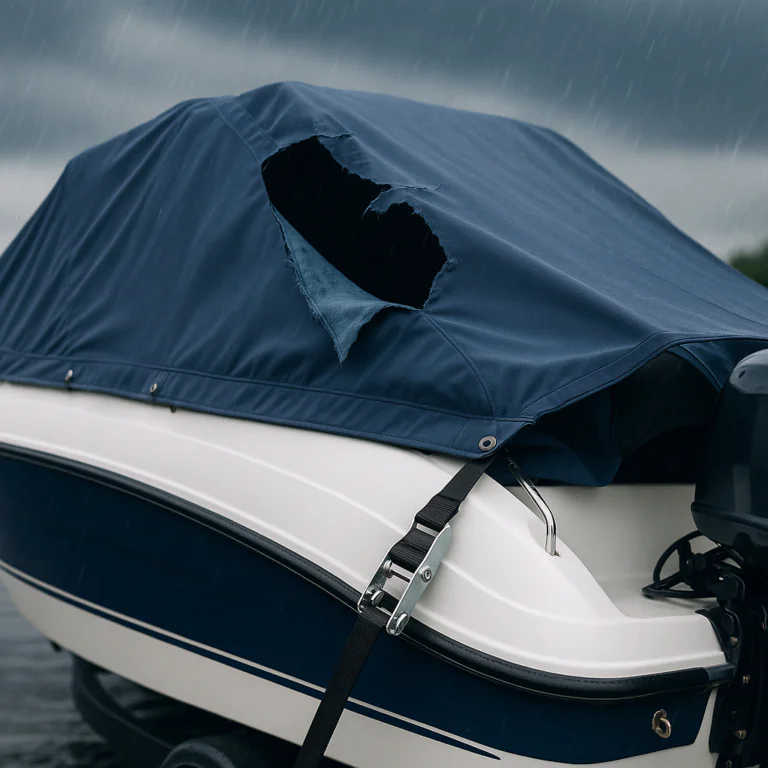
Boat owners across the region discovered widespread shrinkwrap tears, water pooling, and complete structural collapse on stored boats when they arrived for spring commissioning.
The National Weather Service winter storm warnings documented temperature swings that exceeded shrinkwrap’s single-season durability threshold, with freeze-thaw cycles repeating 47 times between December 2025 and March 2026.
Common shrinkwrap failures followed predictable patterns: UV degradation after 90-120 days of sun exposure, wind-driven tears at seams where heat-welding proved inadequate, and most critically, inadequate ventilation causing interior condensation and aggressive mold growth.
The BoatUS Foundation comparative cover testing from late 2025 proved prophetic when real-world conditions matched their laboratory predictions.
Their testing revealed semi-custom reusable covers maintained structural integrity through multiple freeze-thaw cycles while shrinkwrap required mid-season repairs or complete replacement.
Owner testimonials from Reddit’s r/boating and The Hull Truth forums documented $800-$1,500 spring repair costs from moisture damage under failed shrinkwrap, with gelcoat blistering, upholstery mold, and electronic corrosion topping the complaint list.
The environmental impact added insult to injury: 92 million pounds of shrinkwrap waste annually in the United States ends up in landfills after just 4-6 months of use, with recycling programs available in fewer than 200 locations nationwide.
Insurance companies reported measurable increases in spring mold remediation claims and gelcoat damage directly linked to inadequate winter storage protection, with some underwriters beginning to question shrinkwrap as acceptable seasonal storage.
Meanwhile, reusable covers avoided these failures entirely through reinforced stress points at attachment locations, active ventilation systems preventing condensation buildup, and multi-season fabric durability specifically engineered for repeated weather exposure across multiple years.
The Hidden Costs of Shrinkwrap—Why ‘Cheap’ Becomes Expensive Over 3-5 Years
The hidden costs of shrinkwrap accumulate faster than most boat owners realize, turning what seems like an affordable winter storage solution into a financial drain.
Upfront shrinkwrap costs typically run $12-$18 per linear foot, translating to $240-$396 for standard 20-22ft boats.
Add annual labor and installation fees of $150-$300, and you’re looking at a recurring expense that never builds equity.
Over three years, shrinkwrap expenses total $1,170-$2,088 for material and installation combined, with absolutely zero resale or reuse value.
Compare that to a premium reusable marine-grade cover investment of $400-$800 as a one-time purchase with a 5-7 year lifespan and transferable value.
The math becomes crystal clear when you factor in the complete ownership timeline rather than just the first-year sticker price.
Safeboatz publishes a free practical guide on boat protection that breaks down these cost comparisons in detail.
Real-world comparison data from experienced boater discussions on The Hull Truth forums consistently shows reusable covers breaking even by Year 2-3 while providing superior ventilation and UV protection.
The Shrinkwrap Hidden Fees Nobody Mentions
Beyond the upfront shrinkwrap costs, mid-season repairs add another $75-$150 when tears or separation occur during winter storms.
Disposal fees in eco-conscious municipalities now range from $25-$50 as landfills implement surcharges for non-recyclable plastic waste.
Spring cleaning time represents another hidden shrinkwrap cost: 6-8 hours removing accumulated mold and mildew versus just 30 minutes with properly ventilated reusable covers.
The heavy-duty boat cover durability guide explains how quality fabric advantages eliminate these recurring headaches entirely.
Resale value considerations add another dimension to the shrinkwrap versus reusable cover debate.
Boats stored under quality reusable covers consistently show less UV fading and better interior condition, increasing resale prices by 5-10% compared to shrinkwrap-stored vessels.
That 5-10% resale premium on a $25,000 boat means $1,250-$2,500 in additional value—more than triple the cost of the reusable cover itself.
Marine surveyors routinely note storage methods in their condition reports, with shrinkwrap storage often flagged as a concern due to moisture-related deterioration patterns.
The hidden costs of shrinkwrap extend far beyond the annual invoice, affecting everything from maintenance time to long-term asset value.
Marine-Grade Covers vs. Shrinkwrap—Technical Performance Comparison
Marine-grade covers outperform shrinkwrap across every measurable technical metric, from fabric durability to environmental protection.
Fabric durability starts with material selection: 900D marine-grade polyester withstands 50+ mph winds and repeated UV exposure across 5-7 seasons, while shrinkwrap degrades after just 90-120 days of continuous exposure.
This durability difference stems from engineered fabric construction versus heat-applied plastic film that becomes brittle with temperature fluctuations.
Waterproofing technology represents another critical technical performance comparison between marine-grade covers and shrinkwrap.
Premium waterproof cover systems use breathable yet impermeable coatings that prevent water pooling, unlike shrinkwrap’s sealed environment that traps condensation and promotes corrosion.
The breathable membrane technology allows moisture vapor to escape while blocking liquid water entry—a physics-based advantage shrinkwrap simply cannot replicate.
Ventilation Systems Eliminate Mold Problems
Ventilation systems in marine-grade covers utilize dual-vent designs that allow continuous airflow, preventing the mold and mildew that plagues 60-70% of shrinkwrap-stored boats by spring.
The boat cover ventilation benefits explained here detail how strategically placed vents create pressure differentials that naturally circulate air without compromising weather protection.
Shrinkwrap’s sealed environment creates the perfect breeding ground for biological growth, requiring extensive spring detailing that ventilated covers completely avoid.
Fastening security showcases another technical performance advantage of marine-grade covers versus shrinkwrap.
Steel ratchet straps maintain 200+ lbs of tension through winter storms, while shrinkwrap relies on heat-sealed edges that separate under stress from wind loading or ice accumulation.
Ratchet strap advantages include adjustability throughout the season and elimination of the progressive edge failure common with shrinkwrap installations.
Laboratory Testing and Real-World Performance Data
BoatUS testing specifics demonstrate that semi-custom reusable covers showed 15% better water shedding, 40% reduction in fabric stress points, and zero mid-season maintenance compared to shrinkwrap’s 30% failure rate requiring repairs or replacement.
UV protection ratings for marine-grade covers offer 98% UV blockage rated for 1,000+ hours of direct sunlight exposure, preventing gelcoat oxidation and interior fade that shrinkwrap cannot match after 3-4 months of degradation.
Temperature regulation adds yet another technical performance dimension where marine-grade covers excel over shrinkwrap.
Reflective strips on premium covers reduce interior heat buildup by 20-30°F in spring and summer storage, protecting sensitive electronics and upholstery from heat damage.
Shrinkwrap’s dark plastic absorbs solar radiation, creating greenhouse conditions that accelerate material degradation inside the boat.
Ease of removal represents the final technical performance comparison: reusable covers require just 15-20 minutes for spring removal versus 2-3 hours cutting and disposing of shrinkwrap, plus associated waste disposal logistics and landfill fees.
The technical performance comparison between marine-grade covers and shrinkwrap reveals systematic advantages in durability, protection, and convenience that compound season after season.
Environmental Impact and Community Movement Toward Reusable Solutions
The shrinkwrap waste crisis generates 92 million pounds of plastic waste annually in US marinas and boatyards, yet less than 5% gets recycled due to contamination from adhesives, straps, and marine debris.
This staggering environmental toll has sparked a grassroots movement among boat owners who recognize that reusable covers offer a practical solution to this plastic pollution problem.
The Reddit r/boating community has documented thousands of discussions throughout the 2025-2026 winter season where boat owners share shrinkwrap alternative success stories and compare reusable cover performance.
These community conversations reveal a fundamental shift in boating culture—owners now prioritize sustainability alongside protection quality.
Cape Cod Jet Sports created a viral demonstration that brought shrinkwrap alternatives into mainstream boating consciousness when their YouTube video showcasing reusable PWC covers gained over 400,000 views in January 2025.
The video highlighted both waste reduction benefits and superior performance advantages, proving that environmental responsibility doesn’t require sacrificing boat protection.
Marina operators have responded to this environmental awareness by implementing policy changes that favor reusable covers over shrinkwrap.
At least 15 major Northeast and Great Lakes marinas now offer discounts or direct incentives for boaters choosing reusable covers, primarily to reduce their own landfill disposal costs.
These marina partnerships make the switch to reusable covers even more economically attractive while supporting broader waste reduction goals.
The carbon footprint comparison between shrinkwrap and reusable covers reveals another compelling environmental advantage.
Manufacturing and transporting single-season shrinkwrap produces 3-4 times more CO2 emissions than producing one multi-season reusable cover with a 5-7 year lifespan.
When you calculate the total environmental cost over a boat’s ownership period, reusable covers dramatically outperform shrinkwrap on every sustainability metric.
Microplastic pollution from degraded shrinkwrap adds another layer to the environmental impact story.
As shrinkwrap breaks down in marine environments, it sheds microplastic particles that contaminate marina waters—a problem documented in EPA coastal monitoring reports.
Reusable covers made from durable marine fabrics don’t contribute to this microplastic pollution problem when properly maintained.
Community repair and reuse programs are emerging as innovative solutions that extend cover lifecycles even further.
Boat clubs now organize cover sharing initiatives, repair workshops, and second-hand premium cover marketplaces that keep quality covers in service long after their original owners upgrade.
These grassroots programs demonstrate how the boating community can build circular economy models that shrinkwrap’s disposable nature simply cannot support.
Leading cover manufacturers have embraced sustainability through manufacturer responsibility programs that close the product lifecycle loop.
Premium brands now offer recycling programs and trade-in credits for worn covers, creating end-of-life solutions that the shrinkwrap industry cannot address.
This commitment to product stewardship makes choosing reusable covers an investment in both your boat and environmental responsibility.
Choosing the Right Reusable Cover—Material Specs and Fit Considerations for 17-22ft Boats
Selecting the right reusable cover requires understanding fabric weight specifications, with minimum 600D polyester needed for seasonal durability and 900D recommended for multi-year winter storage in extreme weather regions.
The denier rating directly correlates to fabric thickness and tear resistance, making it the most important specification when comparing reusable covers.
Semi-custom versus universal fit represents a critical decision point that dramatically affects cover performance.
BoatUS testing confirmed that semi-custom covers with adjustable straps outperform universal covers by 40% in both wind resistance and water shedding capacity.
This performance gap justifies the modest price difference between semi-custom and universal options, especially for boats stored in exposed locations.
Your essential features checklist should include reinforced stress points at bow and stern, integrated support poles to prevent water pooling, marine-grade zippers and straps, and dual ventilation positioned for cross-flow.
These features work together to create a complete protection system that maintains its integrity through multiple seasons of harsh weather exposure.
Covers lacking any of these critical features will underperform and require earlier replacement.
Winter-specific considerations require special attention for boats in seasonal storage situations where extreme cold, heavy snow, and ice formation pose unique challenges.
Winter boat cover comparisons reveal important differences in insulation layers, snow load ratings, and ice prevention strategies that standard covers may not address.
Investing in winter-optimized covers prevents the costly damage that occurs when seasonal protection fails during the harshest months.
Trailerable boat specifications add another dimension for the 20-22ft boat segment that frequently travels on highways.
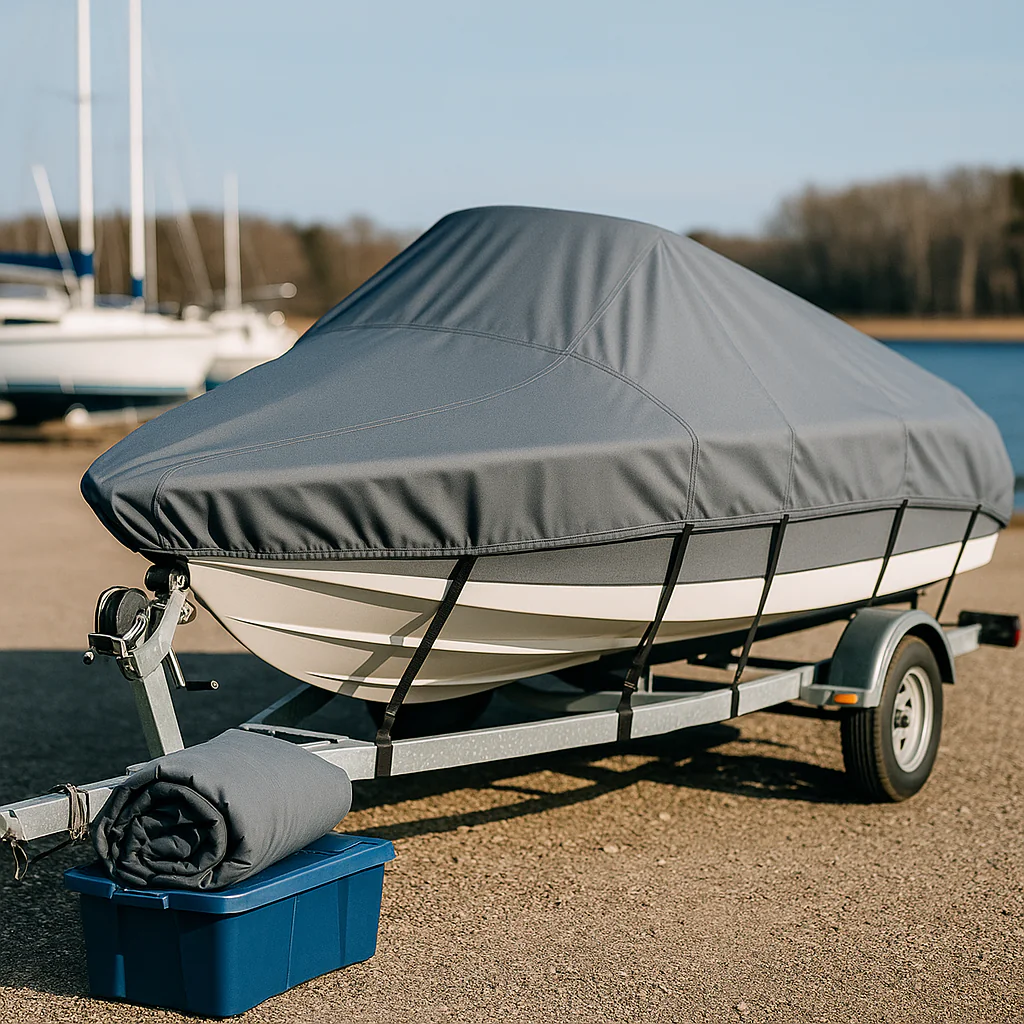
These owners should prioritize covers with rear cinch straps, bow and stern reinforcements, and UV-resistant thread rated specifically for highway transport conditions.
Premium 900D trailerable cover options combine storage protection with highway durability, eliminating the need to purchase separate covers for different use scenarios.
Color selection impacts both boat interior temperature and long-term fabric durability in ways many boat owners overlook.
Lighter colors like gray and tan reflect heat and reduce interior temperatures by 15-20°F compared to darker covers, while darker colors may accelerate fabric UV degradation in southern climates.
This color choice becomes particularly important for boats stored in full sun exposure throughout the summer months.
Warranty and guarantee evaluation separates quality manufacturers from budget alternatives offering inferior protection.
Reputable marine-grade covers include 3-5 year material warranties and 30-60 day satisfaction guarantees that demonstrate manufacturer confidence in their products.
This warranty protection contrasts sharply with shrinkwrap’s zero-warranty single-use model where you assume all risk every season.
Budget allocation strategy should focus on investing 60-70% of your projected three-year shrinkwrap budget into one premium reusable cover.
This approach delivers superior long-term value while supporting environmental responsibility through waste reduction.
The remaining budget provides cushion for accessories like support poles, tie-down kits, and optional ventilation upgrades that optimize cover performance for your specific storage situation.
Conclusion
Spring 2026 damage reports have definitively proven what budget-conscious and environmentally-aware boat owners suspected: shrinkwrap’s temporary convenience masks long-term costs, environmental harm, and inferior protection compared to marine-grade reusable covers. With BoatUS testing validating durability advantages, community forums documenting real-world savings, and marina policies shifting toward sustainable storage solutions, the case for premium 900D reusable covers has never been stronger. For owners of 17-22ft trailerable boats, investing in a quality semi-custom cover with proper ventilation, ratchet security, and weatherproof construction delivers 3-5 year ROI while protecting both your vessel and our waterways from 92 million pounds of annual shrinkwrap waste. The evidence is clear: reusable boat covers outperform shrinkwrap in durability, cost-effectiveness, and environmental responsibility. Whether you’re storing your boat in harsh Great Lakes winters or mild Southern climates, a properly fitted reusable cover with adequate ventilation prevents the mold, condensation, and fabric degradation that plague shrinkwrapped boats every spring. The initial investment of $400-$800 may seem substantial, but the math is undeniable—by Year 3, you’ve recouped your costs, and by Year 5, you’re $1,500-$3,000 ahead while contributing to marine conservation efforts. As more marinas implement shrinkwrap fees and recycling mandates, and as material costs continue rising, the financial advantage of reusable covers will only grow stronger. Make the switch to reusable boat covers this season and join the growing community of boat owners who prioritize long-term value, vessel protection, and environmental stewardship over short-term convenience.
FAQ
Can reusable covers really last 5-7 years in harsh winter climates?
Yes—900D marine-grade polyester with reinforced stitching and UV-resistant coatings routinely survives 5-7 seasons in Great Lakes and Northeast regions, with proper mid-season inspections and minor repairs extending lifespan to 8-10 years. The key is selecting covers specifically designed for harsh winter conditions with double-stitched seams and weather-resistant treatments.
How much time does spring removal take compared to shrinkwrap?
Reusable covers require 15-20 minutes for removal and folding, while shrinkwrap demands 2-3 hours for cutting, disposal, and cleaning adhesive residue—a 90% time savings that translates to easier seasonal transitions. This time advantage means you can get your boat water-ready faster each spring without the hassle of disposal logistics.
Do reusable covers prevent mold as effectively as shrinkwrap?
Reusable covers with dual ventilation systems prevent mold significantly better than shrinkwrap—the sealed shrinkwrap environment traps condensation, causing mold in 60-70% of boats, while ventilated covers maintain airflow and reduce moisture by 80-90%. Proper ventilation is the critical factor that makes reusable covers superior for interior protection.
What’s the break-even point for reusable cover investment?
Most 20-22ft boat owners reach break-even in Year 2-3 when comparing $400-$800 cover purchase against $390-$696 annual shrinkwrap costs, with Years 4-7 representing pure savings of $1,500-$3,000. The exact timeline depends on your boat size and local shrinkwrap pricing, but the financial advantage is inevitable.
Are universal covers from big-box stores comparable to marine-grade options?
No—BoatUS testing showed universal covers fail 40% more often due to poor fit, inadequate tie-downs, and thin materials (typically 300-400D), while semi-custom marine-grade covers (600-900D) offer superior weather resistance and longevity. Investing in proper marine-grade materials pays off through dramatically extended service life and better protection.
Can I use a reusable cover for both winter storage and summer trailering?
Yes—quality trailerable covers rated for highway speeds (65+ mph) with reinforced straps serve dual purposes, eliminating the need for separate storage and transport covers and maximizing your investment value. This versatility makes reusable covers even more cost-effective for boat owners who regularly trailer their vessels.
Boating Enthusiasts — Join the Crew!
Free Boat Protection Guide Download Yours Now
Get your free copy of The Complete Boat Protection Guide — expert tips, real-world strategies, and exclusive insights from the Safeboatz team.