 SafeBOT

Outboard Motor Cover Guide: Trailering, Storage & Fit Checks
A practical guide to choosing and using an outboard motor cover for trailering, outdoor storage, moisture control, and clean fit alongside a Safeboatz Storm Series boat cover.

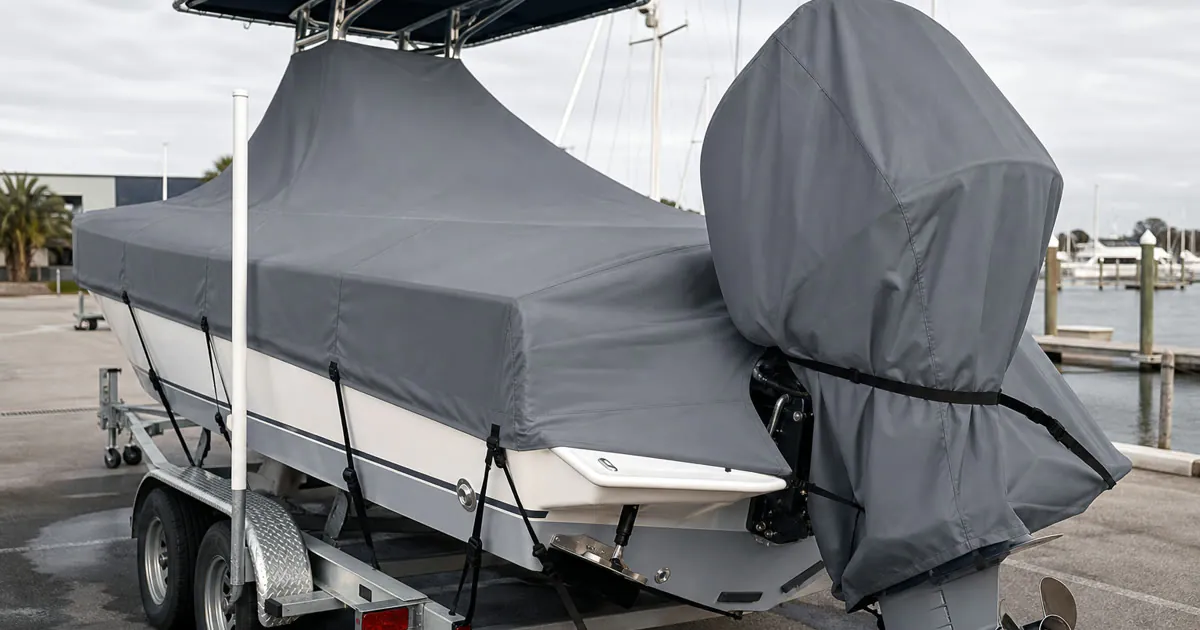
An outboard motor cover protects the cowling and exposed engine surfaces from sun, road grit, rain, salt spray, and storage dust. It is a small piece of gear, but it matters because the outboard is one of the most exposed parts of a trailered boat. A good motor cover should fit snugly, stay put in wind, and work with the way you actually store or tow the boat.
This guide is for boat owners who already think carefully about their main boat cover and want the same level of protection at the stern. It explains when an outboard motor cover makes sense, what to check before trailering with one, how to avoid rubbing the cowling, and how it fits with a trailerable full-boat cover like the Safeboatz Storm Series.
Quick answer: when do you need an outboard motor cover?
You need an outboard motor cover when the engine cowling will sit exposed to UV, road spray, dust, or storage grime for more than a short stop. For driveway storage, marina parking, and road trips, a fitted cowling or full outboard cover helps reduce cosmetic wear and keeps debris away from vents and seams. For trailering, use only a cover that the manufacturer describes as trailerable and inspect the fit before highway speed.
Outboard motor cover vs full boat cover: what each one does
A full boat cover protects the cockpit, bow area, seats, console, deck hardware, and hull opening. A motor cover protects the outboard cowling and, depending on the style, part of the engine leg. They solve different problems. If your boat sits outdoors, the best setup is often a secure trailerable boat cover over the hull plus a separate outboard motor cover sized for the engine.
The Safeboatz trailerable boat cover guide explains the hull-side fit and tie-down logic. This article focuses on the motor end of the same system: the straps, rub points, vents, and trailering checks that decide whether the cover helps or creates a new problem.
The three common outboard cover styles
Most outboard motor covers fall into three practical groups. The right choice depends on whether your priority is storage, towing, or daily sun protection at the dock.
- Cowling-only covers protect the painted upper hood. They are compact, easy to remove, and useful for UV and dust protection.
- Full outboard covers extend farther down the motor. They can help during longer storage periods, but they need more careful sizing around the lower unit and prop area.
- Trailerable motor covers are built to stay on during towing. These need stronger seams, a secure hem, drawcords or straps, and a fit that does not balloon at speed.
If the product page does not clearly say the motor cover is trailerable, treat it as a storage cover only. A cover that works in the driveway can still flap, shift, or abrade the cowling once the boat is moving.
Trailering check: how to decide if the cover can stay on
Before towing with an outboard motor cover, run a five-minute check. The goal is not to make the cover as tight as possible. The goal is to remove wind pockets and prevent the fabric from sawing against the same painted edge for miles.
- Confirm the cover is sold or labeled for trailering.
- Fit it over a clean, dry cowling so grit is not trapped under the fabric.
- Close every zipper, buckle, drawcord, and strap in the order the maker recommends.
- Pull gently at the front, sides, and lower edge. The cover should not lift into a loose balloon.
- Check for hard contact points around decals, cowling corners, vents, and tilt/trim hardware.
- Stop after the first short drive and re-check tension before a longer highway run.
The same logic applies to the main cover. If wind gets under loose fabric, movement starts. The Safeboatz guide to boat cover flapping while trailering explains why loose fabric becomes a bigger problem once road speed and crosswind are involved.
Fit matters more than fabric weight alone
Fabric weight is useful, but fit does most of the work. A heavy cover that is loose can still flap. A lighter cowling cover that follows the engine shape and tightens evenly may protect better for ordinary storage. Look for sizing by horsepower range, engine brand or cowling dimensions, but do not rely on horsepower alone. Two motors with similar horsepower can have different cowling shapes.
Measure the engine before buying: cowling height, width, front-to-back depth, and any lower extension the cover must clear. If the motor has a tall cowl, jack plate, kicker bracket, swim platform, or transom hardware nearby, check those areas too. A cover that technically fits the motor can still rub if the surrounding hardware pushes fabric into the same corner.
Rubbing and gelcoat: the problem most owners notice too late
Motor covers can protect the cowling, but a bad fit can leave rub marks. The risk is highest when the inside of the cover traps grit or when loose fabric moves repeatedly against a decal, painted edge, or vent opening. Clean the cowling first, shake out the inside of the cover, and avoid leaving a damp, dirty cover pressed against the motor for long periods.
If you already worry about rub marks on the hull, apply the same thinking at the stern. The Safeboatz guide on boat cover chafing and gelcoat protection covers the hull-side version of this problem. On an outboard, the equivalent risk points are cowling corners, raised badges, decals, sharp seams, and strap contact zones.
Ventilation: do not trap moisture around the engine
A cover should keep weather and grit off the motor, but it should not seal moisture in forever. After a wet trip, let the engine area dry before long storage when practical. If the outboard cover goes on while the motor is still wet, remove it later and let both surfaces air out. This is especially important in humid climates, after saltwater use, or when the boat is parked where morning condensation is heavy.
The same moisture logic applies under the main boat cover. Vents, slope, and support reduce trapped humidity under the hull cover. See the Safeboatz article on boat cover vents and moisture control if your storage area is damp or the boat sits covered for more than a few days at a time.
Storage checklist for an outboard motor cover
For driveway or yard storage, the outboard cover is part of the larger storage routine. Use it after the motor has been rinsed and the cowling is reasonably dry. Keep the cover off the prop blades unless the product is designed for full lower-unit coverage, and do not block access to drain points or create a pocket where water can collect.
- Clean the cowling before covering so dust does not grind into the finish.
- Let saltwater residue and rinse water dry before long storage.
- Check the cover after storms, especially if wind has shifted the boat cover or trailer angle.
- Remove and dry the cover if it feels damp inside.
- Inspect seams and tie points before the next tow.
How the main boat cover and motor cover should work together
Do not let the main cover pull across the outboard cover in a way that creates tension at the transom. The full boat cover should secure around the hull and cockpit. The motor cover should secure around the engine. If the two overlap, the overlap should lie flat without bunching fabric into a wind scoop.
For 17-19 ft trailerable boats, start with the verified Safeboatz Storm Series 17-19 ft cover. For larger 20-22 ft boats, the current verified Safeboatz option is the Storm Series 20-22 ft cover. Those pages cover the hull and deck protection side. Add a motor-specific cover only after checking your outboard size and trailering needs.
A simple buying checklist
When comparing outboard motor covers, look past the first product photo. The details that matter are usually in the size chart, fastening method, and trailering language.
- Does it match your cowling dimensions, not just a broad horsepower range?
- Does the maker clearly say it can be used while trailering?
- Does it tighten below the cowling without rubbing decals or vents?
- Can you remove it quickly at the ramp without fighting wet straps?
- Does the fabric feel appropriate for your climate: sun exposure, salt air, rain, storage dust, or road grime?
- Is the warranty and return policy clear enough if the fit is wrong?
For towing and boating safety basics beyond the cover itself, review your trailer, tie-downs, lights, load, and local weather before every trip. The National Weather Service safety resources are useful before a tow day, and the U.S. Coast Guard recreational boating resources are worth keeping bookmarked for broader boating safety checks.
FAQ: outboard motor cover questions
Should you put a cover on your outboard motor?
Yes, an outboard motor cover is useful when the engine sits exposed to sun, dust, rain, road spray, or storage grime. Use a clean, well-fitted cover and remove it periodically so trapped moisture can dry.
Can you trailer with an outboard motor cover on?
You can trailer with an outboard motor cover only if the cover is designed for trailering and fits snugly. If it balloons, flaps, or rubs the cowling, remove it before towing.
What is the difference between a cowling cover and a full outboard cover?
A cowling cover protects the upper hood. A full outboard cover extends farther down the motor and may protect more exposed surfaces during storage. Full covers need more careful fit checks around the lower unit and prop area.
Will an outboard motor cover trap moisture?
It can if the motor or cover is wet and the boat sits covered for a long period. Let the cowling dry when possible, and remove the cover periodically in humid or saltwater conditions.
Do you still need a main boat cover?
Yes. An outboard motor cover protects the engine area, not the cockpit, seats, bow, console, or deck. Use a secure full boat cover for the hull and a separate motor cover when the outboard needs extra protection.
Bottom line
An outboard motor cover is worth considering if your boat spends real time on a trailer, in a driveway, or parked outdoors between trips. Fit it like trailering gear, not like a loose dust sheet. Keep it clean, check for rub points, and pair it with a properly tensioned full-boat cover so the hull and engine are both protected.
If you are choosing the hull cover at the same time, start with the Safeboatz Storm Series sizing pages for 17-19 ft boats and 20-22 ft boats, then match the outboard motor cover separately to your engine cowling.
Boating Enthusiasts — Join the Crew!
Free Boat Protection Guide Download Yours Now
Get your free copy of The Complete Boat Protection Guide — expert tips, real-world strategies, and exclusive insights from the Safeboatz team.