

SafeBOT
Welcome aboard! I’m SafeBOT, your virtual assistant.
How can I help you today?
SafeBOT is typing...

Wind Damaged Boat Cover: Why Strong Covers Survive 2026

Spring Wind Storms 2026: Why Strong Boat Covers Survive When Cheap Ones Fail

Introduction

Spring Wind Storms 2026: Why Strong Covers Last is a critical topic as March 2026 witnesses unprecedented spring wind storms across North America, catching boat owners off-guard as they prepare for launch season.

YouTube reports from March 23, 2026 document real-time cover failures, with cheap covers shredding in high winds while premium marine-grade alternatives hold firm.

This outline explores why proper cover construction, secure fastening systems, and material quality determine whether your boat survives spring storm season intact—or suffers catastrophic wind damage during the critical transition from winter storage to on-water use.

The difference between a destroyed budget cover and a premium marine-grade cover holding firm under 50 mph gusts comes down to engineering, materials, and proper installation protocols that most boat owners overlook until it’s too late.

Spring 2026 Wind Storm Patterns and Boat Cover Vulnerability

Spring wind storms in 2026 are creating unprecedented challenges for boat owners as they transition from winter storage to launch readiness across North America’s waterways.

Increased frequency and intensity of spring wind events documented in NOAA’s 2026 severe weather outlook show that boaters face higher risk during the March-May commissioning period when covers experience maximum stress from both winter wear and sudden weather changes.

Regional hotspots including the Great Lakes, coastal Northeast, Pacific Northwest, and inland waterways are experiencing sustained 35-50 mph gusts with minimal warning, leaving boat owners scrambling to secure or replace inadequate protection systems.

The NOAA Spring 2026 Severe Weather Outlook provides official forecast data showing increased spring severe weather frequency and intensity for 2026, confirming what marina operators and boat owners are witnessing firsthand.

Critical timing makes these spring wind storms particularly destructive: wind events coincide with spring cover removal and pre-launch inspections when covers are already stressed from winter wear, creating perfect conditions for catastrophic failure.

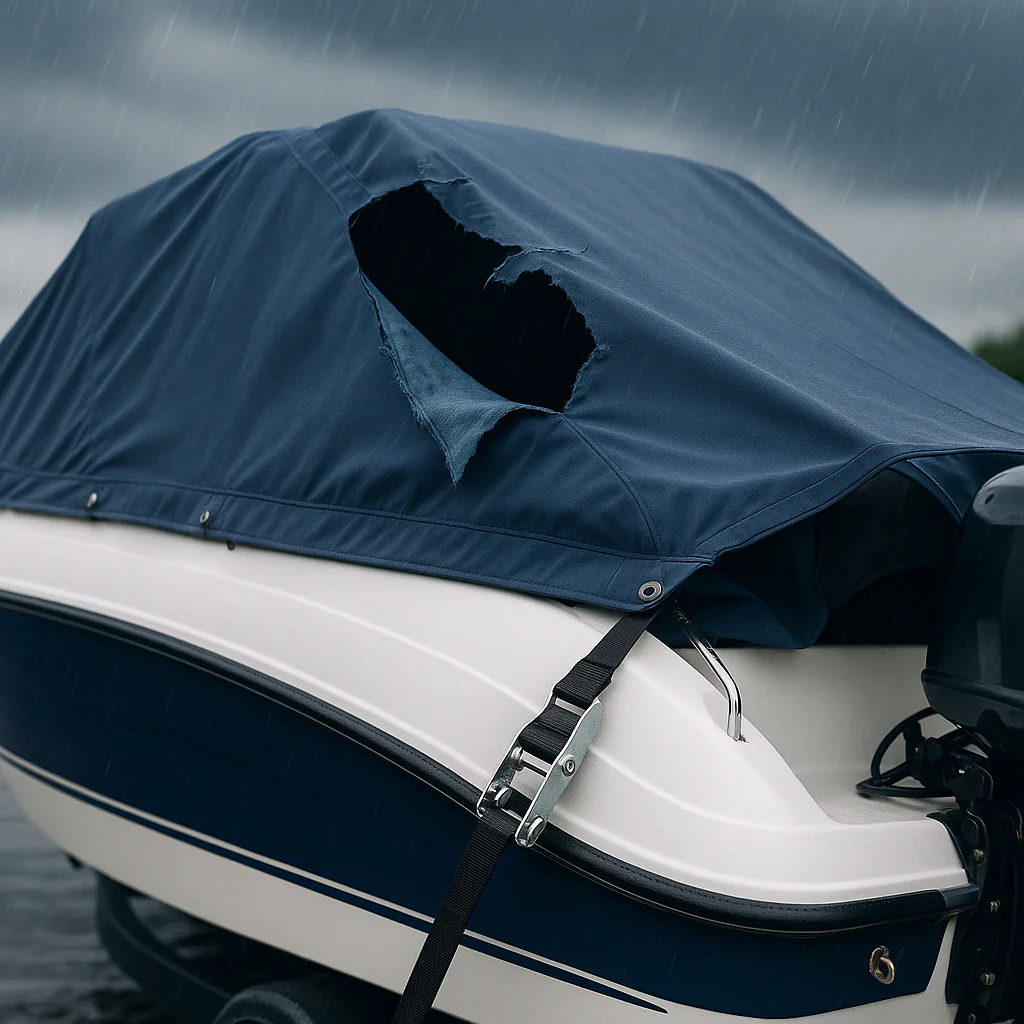
Why cheap covers fail catastrophically comes down to basic physics—loose fit creates a billowing effect that amplifies wind force, turning covers into destructive sails that tear at seams and attachment points with exponentially increasing force.

Documented failure modes observed across marinas this spring include hem separation, strap breakage, fabric tearing along stress points, and complete cover displacement exposing hulls to UV and precipitation damage.

The National Weather Service severe weather pattern analysis provides authoritative data on spring wind storm frequency and regional patterns affecting boat owners, helping explain why 2026 is proving particularly challenging.

The economic impact of inadequate spring wind storm protection extends far beyond the cover itself: emergency repairs, gelcoat damage from UV exposure, and interior water damage from displaced covers far exceed the cost of quality protection invested upfront.

Marina operators report that boats with properly fitted, marine-grade covers with reinforced attachment systems emerge from spring wind storms undamaged, while nearby vessels with budget covers suffer thousands in preventable damage.

Engineering Differences Between Wind-Resistant and Standard Boat Covers

Engineering differences between wind-resistant and standard boat covers determine whether your vessel survives spring storms intact or suffers thousands in gelcoat and upholstery damage.

The fundamental distinction starts with fabric weight and tear resistance that separates professional-grade protection from economy alternatives.

Fabric Weight and Material Engineering

Wind-resistant boat covers utilize 900D marine-grade polyester that withstands wind stress capable of shredding 300D-600D economy fabrics within minutes of sustained gusts.

900D fabric engineering provides material density that resists tearing from wind stress through tighter weave patterns and reinforced thread construction.

When a 35 mph gust hits your boat cover, the fabric must absorb and distribute that kinetic energy without compromising structural integrity—something thin polyester alternatives consistently fail to achieve.

Standard boat covers marketed at budget price points typically use 300D-450D polyester that feels adequate in calm conditions but lacks the tensile strength required when spring winds exceed 25 mph sustained speeds.

Hem Construction and Tension Systems

Reinforced hem construction separates covers that stay secured from those that billow and tear during wind events.

Double-stitched elastic hems with marine-grade rubber maintain continuous tension around the boat’s perimeter, preventing the « parachute effect » that destroys loose-fitting covers when wind gets underneath the fabric.

Elastic hem engineering and tight fit specifications reveal how tension maintenance systems prevent wind-driven cover failure through consistent pressure distribution.

The hem must create an air-tight seal that eliminates gaps where wind can penetrate—once air flows beneath a boat cover, the fabric transforms into a sail that generates lift forces exponentially stronger than direct wind pressure alone.

Strap Attachment and Load Distribution

Steel ratchet systems provide 300+ pounds of adjustable tension that holds covers firmly in 40+ mph winds, while standard elastic straps stretch beyond effectiveness and fail at 25-30 mph wind speeds.

Seam reinforcement at high-stress points utilizes bar-tack stitching at strap attachment locations, distributing wind load across the fabric structure rather than concentrating stress at single failure points where tears initiate.

Budget boat covers attach straps through simple straight stitching that creates stress concentration zones—the first component to fail when wind forces exceed the thread’s breaking strength.

Boaters on The Hull Truth forums document specific cover failure patterns during spring storms, with strap separation and hem detachment representing the most common damage modes.

Safeboatz’s free boat protection guide provides comprehensive analysis of material specifications and engineering features that differentiate wind-resistant covers from standard alternatives.

Ratchet and Strap Systems That Survive Spring Wind Events

Ratchet and strap systems that survive spring wind events incorporate adjustable tension mechanisms and strategic geometry that budget covers completely lack.

The critical difference lies in how these systems respond to dynamic wind forces that change intensity throughout storm cycles.

Adjustable Tension and Dynamic Wind Response

Adjustable tension matters because wind forces change dynamically during storms—ratchet systems allow precise tensioning that maintains cover stability across varying wind speeds from calm to severe gusts.

Ratchet system engineering advantages demonstrate why steel ratchet mechanisms provide superior storm protection and trailering stability compared to fixed-length elastic alternatives.

When a spring cold front approaches, experienced boaters increase ratchet tension to 80-90% of maximum capacity, creating a cover installation that can withstand 45+ mph gusts without fabric movement.

Standard bungee cord systems cannot achieve this level of customization—they provide fixed tension determined by cord length and elasticity, with no ability to adjust for anticipated severe weather.

MK2 Ratchet Engineering Specifications

MK2 ratchet upgrade advantages include corrosion-resistant steel construction that withstands marine environments while providing one-handed adjustment for quick pre-storm tensioning.

MK2 engineering with upgraded ratchets handles highway wind forces and spring storms on 17-19ft boats through precision-machined steel components that maintain tension under sustained load.

The ratchet mechanism locks in 1-inch increments, allowing boaters to fine-tune tension around the boat’s perimeter and compensate for hull geometry variations that create uneven fabric stress distribution.

Budget covers using plastic buckles experience catastrophic failure when those components crack below freezing during late winter, then completely separate during the first significant spring wind event.

Strategic Strap Placement Geometry

Strap placement geometry creates the structural framework that determines whether wind forces distribute evenly or concentrate at failure points.

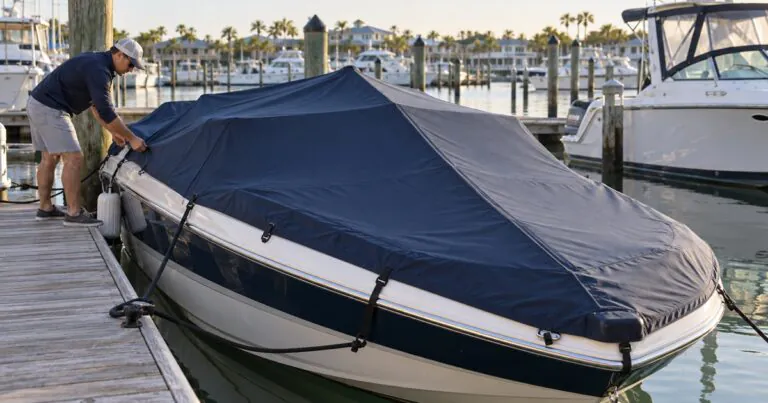
Strategic positioning at bow, stern, and mid-sections creates a triangulated tension network that distributes wind load evenly across the cover surface, preventing the localized stress that initiates tears.

Secure strap and wind-proofing design specifications detail strap systems that prevent cover displacement during severe spring weather through calculated anchor point positioning.

The bow strap must angle toward the trailer tongue at 30-45 degrees to counteract lift forces generated when wind flows over the boat’s profile—vertical-only strap angles provide inadequate resistance to the upward wind component.

Real-World Failure Analysis

Common failure points in budget covers follow predictable patterns: plastic buckles crack below freezing then fail in spring winds; sewn-on straps separate at stitching locations; insufficient strap length prevents proper tensioning around larger hull sections.

Boaters on r/boating community provide real-time reports of wind damage to inadequate covers during the current spring season, with photos documenting torn fabric, separated hems, and broken plastic components.

The cost difference between wind-resistant ratchet systems and budget alternatives typically ranges from $40-80, while the cost to repair gelcoat damage from a single uncovered spring storm averages $800-1,500 per incident.

Preventing Wind Damage During Spring Storage Transitions

Preventing wind damage during spring storage transitions requires a proactive approach that combines regular inspection, proper tensioning, and weather monitoring to protect your boat cover investment.

Spring weather creates unique challenges for boat cover wind resistance as temperature fluctuations, sudden storms, and high winds test even the best-secured covers during the transition from winter storage to launch season.

Pre-Storm Inspection Protocols

A comprehensive pre-storm inspection checklist should be performed weekly during the volatile March-April period when spring storms are most frequent and severe.

Check strap tension systematically around the entire boat cover perimeter, examining each attachment point for signs of loosening or material degradation that occurred during winter storage.

Examine hem elasticity carefully for winter degradation, as freeze-thaw cycles can compromise elastic components that are critical for maintaining proper boat cover wind resistance throughout storm events.

Verify all ratchets engage fully without slippage by testing each mechanism under load—even slightly worn ratchets can fail completely when wind forces increase during severe weather.

Optimal Tensioning Techniques

Covers should be drum-tight with no loose fabric that can catch wind and create the billowing effect that leads to catastrophic cover failure during spring storms.

Hand pressure should not create more than 1-2 inches of deflection in properly tensioned boat covers, providing the taut surface that allows wind to flow smoothly over rather than catching underneath.

Proper boat cover wind resistance depends on eliminating all potential catch points where wind can penetrate beneath the cover and create the internal pressure that lifts covers away from hull surfaces.

Weather Monitoring and Response Protocols

Set severe weather alerts specifically for your marina or storage location using weather apps that provide wind speed predictions and storm timing for proactive boat cover preparation.

Plan to increase strap tension 12-24 hours before predicted wind events above 30 mph, as this window allows you to reinforce boat cover wind resistance before conditions become dangerous for cover adjustment.

Emergency reinforcement tactics include adding supplemental tie-downs at bow and stern when severe weather threatens, creating additional anchor points that distribute wind loads across more attachment locations.

Use cam straps underneath the hull for additional anchoring on trailers, securing the entire boat-and-cover system to the trailer frame rather than relying solely on perimeter attachment points.

Documentation and Damage Assessment

Document wind damage discovered during spring cover removal by photographing any tears, strap failures, or hull damage that occurred when boat cover wind resistance was overcome by severe weather events.

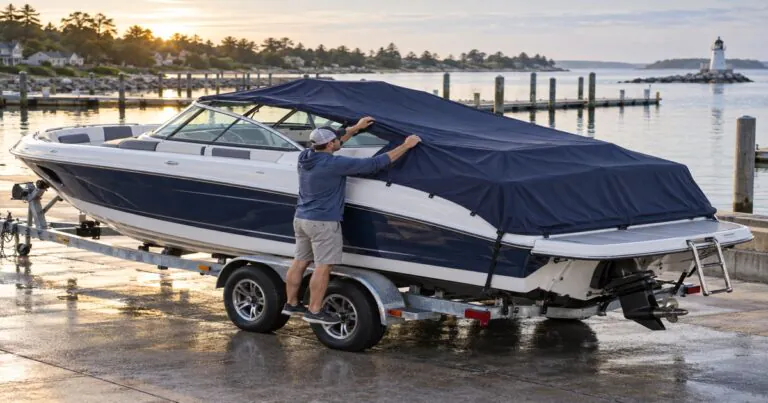
Post-storm damage assessment should be performed immediately after major wind events by removing covers to check for water intrusion, fabric tears, or strap damage that could worsen in subsequent storms.

This documentation process creates valuable records for insurance claims while also providing insights into which boat cover wind resistance strategies worked and which require improvement for future seasons.

Trailered Boat Considerations

Highway speeds create equivalent wind forces to 50+ mph storms when towing, meaning covers designed for trailering automatically provide superior storm protection when parked at storage facilities.

Trailerable covers typically feature reinforced attachment systems and higher-quality fabrics that deliver better boat cover wind resistance than standard storage covers during spring weather transitions.

DiscoverBoating spring boating safety and storage preparation provides industry association guidance on securing boats during spring weather transitions when wind damage risk is highest.

The investment in trailerable-grade covers pays dividends during spring storage as these covers routinely withstand wind conditions that destroy standard covers, protecting your boat during the most weather-volatile months of the year.

Conclusion

Spring 2026’s unprecedented wind storms are separating quality boat covers from inadequate alternatives in real-time across North America. The engineering differences are clear: 900D marine-grade fabrics, steel ratchet systems, and reinforced elastic hems provide the structural integrity necessary to survive sustained winds above 40 mph, while economy covers with lightweight materials and basic elastic straps fail catastrophically. As climate patterns shift toward more frequent severe weather events, investing in wind-resistant cover technology isn’t optional—it’s essential protection for your vessel during the vulnerable spring transition period. Proper cover selection, regular tensioning, and proactive storm preparation will determine whether your boat emerges from spring storm season unscathed or requires extensive repair before launch. The evidence from this spring’s damage reports confirms that boat cover wind resistance directly correlates with material quality, strap system engineering, and owner maintenance diligence. Don’t wait for the next wind event to test your cover’s capabilities—assess your current setup against the standards outlined here, make necessary upgrades, and implement the tensioning protocols that separate protected boats from damaged ones. Your investment in proper wind-resistant boat covers and proactive storm preparation will pay dividends in avoided repair costs, preserved resale value, and peace of mind throughout every spring storm season ahead.

FAQ

What wind speed causes most boat cover failures?

Most economy covers begin failing at sustained winds of 25-30 mph, with catastrophic failures occurring above 35 mph. Quality marine-grade covers with ratchet systems typically withstand 40-50 mph winds when properly tensioned.

Can I upgrade my existing cover’s wind resistance?

Partial upgrades are possible: Replace elastic cords with adjustable cam straps, add supplemental tie-down points underneath the hull, and ensure maximum tension. However, fabric quality and hem construction cannot be modified—if your cover is lightweight polyester (under 600D), replacement is the only reliable solution for high-wind areas.

How often should I retension my boat cover during spring?

Check and adjust tension weekly during March-May storm season. Increase tension 12-24 hours before predicted wind events above 30 mph. After any storm with sustained winds above 25 mph, inspect all straps and retension as needed.

Are trailerable covers better for wind protection than storage covers?

Yes—trailerable covers are engineered for highway wind speeds (equivalent to 50+ mph gusts), making them inherently more wind-resistant. The tight fit, reinforced hems, and robust strap systems designed for trailering provide superior storm protection even when the boat is stationary.

What’s the most common mistake that leads to spring wind damage?

Insufficient tensioning is the primary culprit. Boat owners often leave covers loosely fitted after winter, allowing wind to get underneath and create destructive lifting forces. Even quality covers will fail if not properly tensioned—the fabric should be drum-tight with minimal slack.

Should I remove my cover before a major storm to prevent damage?

No—removing a cover exposes your boat to far greater damage from wind-blown debris, precipitation, and UV exposure. Properly tension the cover and add supplemental tie-downs if needed. Only remove covers after storms to assess any damage and prevent water accumulation.

Boating Enthusiasts — Join the Crew!

Free Boat Protection Guide Download Yours Now

Get your free copy of The Complete Boat Protection Guide — expert tips, real-world strategies, and exclusive insights from the Safeboatz team.

Get My Free Guide
Safeboatz Team
Safeboatz Team
Articles: 46
🎁

Wait! Don't Leave Empty-Handed!

Get your FREE Boat Protection Guide with expert tips to keep your boat protected all year round.