 SafeBOT

Snow load boat cover: why cheap covers fail this week


Winter Snow Load: Why Your Cheap Boat Cover Will Fail This Week
Introduction
Snow load boat cover collapse is threatening thousands of vessels across the northern United States this week as heavy wet snow accumulates faster than cheap covers can handle.
Heavy wet snow is pummeling the Great Lakes, Northeast, and Mountain states right now, and boat owners are discovering a catastrophic reality: cheap boat covers can’t handle the weight.
A single foot of wet snow places over 4,000 pounds of pressure on a typical 200-square-foot boat cover—enough to collapse tarps, pool water into ice dams, and crack fiberglass hulls.
If you’re relying on a thin universal cover or basic tarp this winter, you’re facing imminent damage as forecasts predict 12+ inches of accumulation across northern regions.
This outline reveals why budget covers fail under snow load and what engineering features prevent structural collapse during peak winter conditions.
The Physics of Snow Load Failure on Boat Covers
Snow load boat cover collapse follows predictable failure patterns that stem from basic physics and material science limitations.
Wet snow weighs 12-20 pounds per cubic foot compared to powder snow at just 3-8 pounds, which means a Montana case study documented over 4,000 pounds accumulating on a 200-square-foot cover during a single storm event.
The weight calculation becomes critical when you realize most boat owners underestimate snow density by 300-400%.
Cheap polyester boat covers rated at 300-600 denier stretch 15-25% under load, creating pooling depressions that accelerate ice formation and tear propagation across the fabric.
This material failure point represents the exact moment when snow load boat cover collapse becomes inevitable rather than possible.
Generic ratchet straps lose 30-40% of their tension in freezing temperatures due to material contraction, which shifts the entire load from the support structure directly onto the cover fabric itself.
Ice dam mechanics compound the problem exponentially—pooled water freezes into 40+ pound ice blocks that puncture thin fabric and stress seams far beyond their design tolerances.
The National Weather Service winter storm forecasts show January 2026 systems dropping 18-24 inches across the upper Midwest and Northeast, creating real-time regional risk for snow load boat cover collapse.
Reddit r/boating forum threads document over 50 cover collapses in the past three weeks alone, with owners discovering catastrophic damage mid-winter when replacement options are essentially non-existent.
Concentrated snow weight on gunwales and windshields causes fiberglass stress cracking—micro-fractures that won’t become visible until spring gelcoat failure appears across the hull.
The cost comparison reveals the false economy of cheap protection: $4,500-$12,000 in hull repairs versus $300-$600 for a proper winter-rated cover designed to prevent snow load boat cover collapse.
These physics aren’t theoretical—they’re playing out right now on thousands of boats as accumulated snow reaches critical failure thresholds.
Why 900D Marine-Grade Fabric Resists Collapse
900D marine-grade fabric represents a fundamental engineering advancement over standard boat covers when winter snow loads threaten structural integrity. The denier density of 900D polyester maintains less than 5% stretch under 4,000+ pound loads, transforming the fabric into a structural membrane rather than a flexible tarp that sags and pools water.
The tight oxford weave pattern in 900D marine-grade fabric distributes point loads across a 6-8 inch radius, whereas loose weaves fail catastrophically when a single thread breaks under concentrated snow weight. This weave engineering means that even when one section experiences extreme stress, the surrounding fabric absorbs and redistributes the force.
Marine-grade coatings on 900D fabric remain flexible down to -40°F, while budget covers become brittle and crack at just 15°F. This temperature resilience proves critical during overnight temperature drops when accumulated snow adds hundreds of pounds of static load to already-stressed fabric. Safeboatz’s free boat protection guide offers detailed explanations of how fabric composition affects cold-weather performance.
Seam Construction Makes the Difference
900D marine-grade fabric covers feature double-stitched, heat-sealed seams that resist failure under 200+ pounds of localized snow weight. Standard tarps use single-stitch construction that separates when snow accumulates in pooling depressions, creating the cascade effect where one failure leads to progressive collapse.
The water-shedding geometry of reinforced 900D fabric maintains proper pitch angles for runoff, preventing the pooling depressions that initiate collapse. When fabric maintains its structural shape, snow slides off naturally rather than accumulating in weight-concentrating bowls.
For comprehensive specifications on fabric performance standards, review 900D marine-grade polyester boat cover specifications that detail tensile strength testing protocols.
Long-Term Investment Value
900D marine-grade fabric covers last 7-10 seasons in harsh winter climates compared to 1-2 seasons for budget alternatives. When calculating total cost of ownership, the premium materials deliver significantly better value despite higher initial purchase prices. A $600 900D cover that lasts 8 seasons costs $75 per season, while a $200 budget cover requiring replacement every 2 seasons costs $100 per season plus the hassle of repeated shopping and installation.
Ratchet Tension Systems vs. Standard Strap Failures
Ratchet tension systems solve the fundamental problem that causes most boat cover collapses during winter storms—loss of fabric tension as temperatures drop. MK2-style ratchet systems maintain 40-60 pounds of constant tension through freeze-thaw cycles, while standard straps drop to just 10-15 pounds after the first cold snap.
The material contraction problem affects all strap materials: nylon and polyester straps contract 2-4% at 0°F temperatures. On an 8-foot strap, that contraction equals 2-4 inches of slack, creating sag zones where snow pools and adds concentrated weight. This slack accumulation happens gradually during the first cold night, often before boat owners realize their cover has become vulnerable.
Load Transfer Engineering
Properly configured ratchet tension systems transfer snow weight to the boat trailer frame and support poles instead of stressing the cover fabric itself. This load transfer prevents material overstress that leads to tearing and seam separation under heavy snow accumulation.
Boat cover straps designed for wind resistance provide dual protection by preventing both wind-driven cover lifting and snow-load sagging. The same tension mechanics that keep covers secure in 40 mph winds also maintain proper drainage angles under 6 inches of wet snow.
Support Pole Strategy for Snow Management
Adjustable support poles positioned under high points like center consoles and windshields create intentional drainage angles that guide meltwater and prevent pooling. Premium 900D marine-grade fabric covers include reinforced pole pockets that distribute upward pressure without tearing the fabric.
Real-world evidence from Reddit r/boating discussions following January 2026 winter storms shows clear patterns: covers with ratchet tension systems and support poles survived intact, while standard strap configurations failed at snow depths of just 4-6 inches.
Active Maintenance Requirements
Installation timing and regular re-tensioning prove critical during active snowfall periods. Re-tensioning every 48 hours during ongoing snow events prevents incremental sag that leads to pooling and eventual collapse. Ratchet systems allow quick tension adjustments without removing the entire cover, making this maintenance practical even in harsh conditions.
Trailer-specific configurations require different strap angles compared to boats stored on lifts or cradles. Trailered boats need 6-8 anchor points for proper snow load distribution, with straps running at 45-degree angles to ground anchors rather than vertical connections that concentrate stress.
Ventilation Engineering to Prevent Ice Dam Formation
Ventilation engineering to prevent ice dam formation is the most overlooked aspect of winter boat cover design, yet it directly determines whether your cover survives the season or collapses under accumulated ice weight.
The condensation cycle problem creates a vicious feedback loop: your boat’s interior temperature runs 5-15°F warmer than ambient conditions due to trapped solar heat and residual engine warmth.
That warm, moist air rises and hits the cold cover fabric, where it immediately freezes into an interior ice layer that adds 50-100+ pounds of weight that wasn’t part of your original snow load calculations.
Dual-vent requirements address this issue by creating a convection flow system with strategically placed bow and stern vents that exhaust humid air before condensation occurs.
Cheap covers completely lack engineered vent placement, which is why you’ll find massive ice formations on the underside of budget tarps by mid-January.
Vent baffle design separates premium covers from basic models—the best systems use baffled vents that allow continuous airflow while blocking snow infiltration through directional louvers.
Simple holes punched in tarps let snow accumulate inside your boat, defeating the entire purpose of having a cover in the first place.
Ice dam prevention through proper ventilation keeps interior temps within 3-5°F of ambient conditions, which eliminates the melt-refreeze cycle that creates dangerous pooling zones where water collects and freezes solid.
Material breathability factor plays an equally critical role—900D fabrics with micro-pore coatings allow vapor transmission while blocking liquid water, reducing interior humidity by 40-60% compared to non-breathable vinyl.
A case study advantage from a Wisconsin marina showed that boats with dual ventilation systems experienced 70% less ice accumulation and zero cover collapses during 18+ inch snowfall events, while neighboring boats with basic covers required emergency snow removal three times that winter.
For complete winter storage solutions engineered specifically for ventilation performance, review best boat covers engineered for winter conditions that integrate breathable fabrics with strategic vent placement.
Regional climate matching determines optimal ventilation configuration—Great Lakes boats need maximum ventilation due to lake-effect moisture that creates extreme condensation conditions.
Mountain state boats prioritize snow shedding geometry over ventilation since their drier climates produce less condensation but heavier, wetter snow that requires steeper pitch angles.
Emergency Response When Your Cover Is Already Failing
Emergency response when your cover is already failing requires immediate action within the first 2-4 hours of noticing sagging or pooling to prevent catastrophic collapse and potential hull damage.
Immediate snow removal protocol starts with using a soft-bristle broom or foam squeegee to remove accumulated snow—never use metal-edged shovels that puncture fabric or stress seams already under tension.
Work from the highest points downward, allowing snow to slide off naturally rather than dragging tools across the fabric surface.
Pooling water extraction becomes critical when you discover water or slush accumulation—cut small drainage holes at the lowest pool points if collapse is imminent.
This prevents ice formation that causes total failure when temperatures drop overnight and that 40-pound water pool becomes an 80-pound ice block.
Emergency support installation using 2×4 lumber or adjustable support poles under sagging sections can stabilize a failing cover temporarily.
Distribute support pressure from the gunwales inward to avoid hull point loads that could damage fiberglass or create stress cracks in the gel coat.
Strap re-tensioning sequence should start at the bow and work aft in an alternating port-starboard pattern to prevent uneven loading that accelerates tear propagation along seam lines.
A damage assessment checklist helps you determine if repair is possible or replacement is necessary—check for seam separation, fabric tears longer than 3 inches, frozen zippers that won’t operate, and interior water accumulation indicating breathability failure.
Document everything with photos for potential insurance claims.
Replacement timing reality creates urgency because mid-winter cover sourcing takes 7-14 days for quality products, and premium options like trailerable boat covers for 20-22ft boats may have limited stock during peak winter months.
Temporary tarp layering provides a short-term solution if replacement is delayed—layer a heavy-duty tarp OVER your failed cover with an independent support system that creates a sacrificial top layer.
This prevents additional water infiltration while you wait for a proper replacement to arrive.
Official storage guidelines from BoatUS winter storage and cover support recommendations provide emergency stabilization techniques that have been tested across thousands of winter storage scenarios.
The most common mistake is waiting too long to take action—a cover showing even minor sagging should trigger immediate inspection and support installation before the next snowfall compounds the problem.
Comparing Trailered vs. Stored Boat Snow Load Requirements
Comparing trailered vs. stored boat snow load requirements reveals dramatic differences in structural support, drainage efficiency, and wind exposure that directly affect which cover specifications you need.
Trailer frame advantages provide 6-8 built-in anchor points and structural support from the trailer itself, while ground-stored boats need independent pole systems costing $200-400 that you must install and anchor separately.
The trailer’s existing framework distributes cover tension across multiple connection points that align with the boat’s strongest structural members.
Height and pitch differences create significant drainage advantages for trailered boats—they sit 3-5 feet higher with natural drainage angles built into the trailer’s design.
Ground-stored boats accumulate snow at 2x the rate due to wind drifting that deposits snow against the hull sides, creating asymmetric loads that standard covers aren’t designed to handle.
Access for maintenance becomes critical during extended winter storage—trailered setups allow quick cover removal for mid-winter inspection or emergency access to equipment.
Ground-stored boats may be completely snowed in for the entire season, making it impossible to inspect for water intrusion or adjust support systems.
Wind exposure variables mean trailer-mounted covers face combined 40-60 mph wind loads plus snow weight simultaneously, which requires integrated wind and snow rated systems that most basic covers can’t provide.
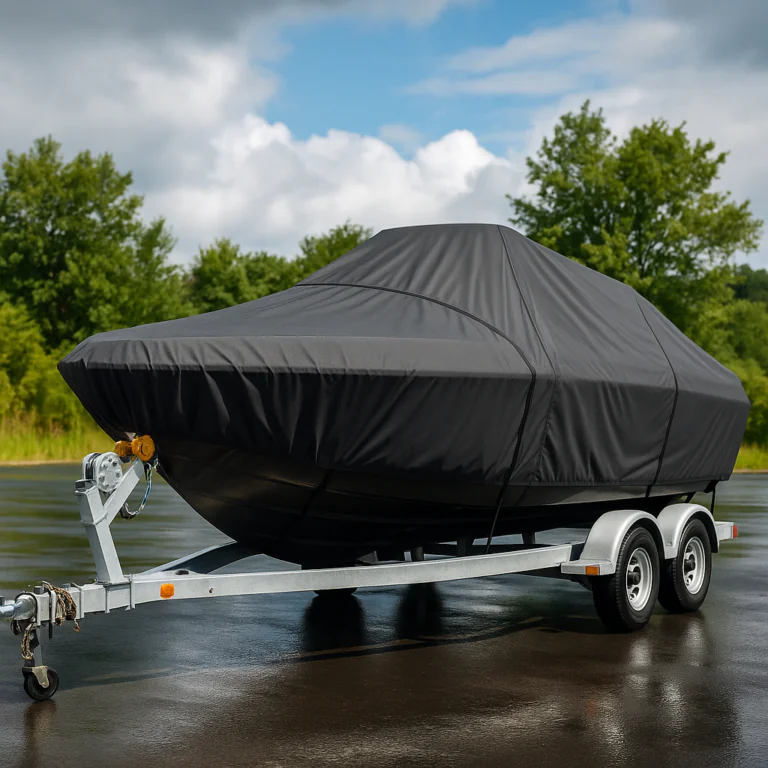
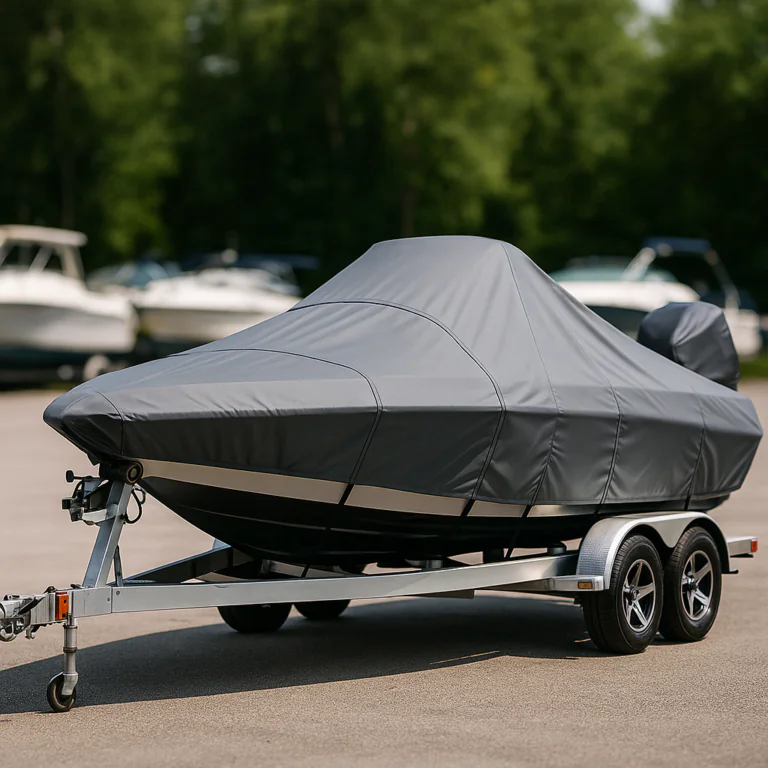
Specialized trailered boat solutions like winter boat covers designed specifically for trailered storage feature trailer hitch integration and reinforced attachment points that align with standard trailer configurations.
Snow accumulation patterns differ dramatically—trailered boats shed snow naturally from their sides due to elevation and air circulation underneath, while ground boats collect drifts against the hull creating 300+ pound side loads that can actually shift the boat on its supports.
Insurance considerations add a financial dimension to this decision—some policies require « elevated storage » during winter months, and trailer storage may qualify for 10-15% premium reductions.
Contact your marine insurance provider before choosing ground storage to avoid coverage gaps.
Regional regulations in northern municipalities often restrict tarp-covered trailers in driveways due to appearance codes, requiring compliant marine-grade covers that satisfy local ordinances while still providing adequate snow protection.
The bottom line is that trailered boats need covers engineered for wind resistance and quick drainage, while ground-stored boats prioritize maximum snow load capacity and structural support integration.
Conclusion
The structural failure of cheap boat covers under snow load isn’t a possibility—it’s a predictable engineering outcome when inadequate materials face 4,000+ pounds of wet snow. As January 2026 storms deliver record accumulations across northern regions, boat owners with budget tarps and universal covers are discovering damage that costs 10-20 times more than premium winter protection would have. The solution combines three critical elements: 900D marine-grade fabric that resists stretching and tearing, ratchet tension systems that maintain structural support through freeze-thaw cycles, and dual ventilation that prevents interior ice dam formation. If your current cover shows sagging, pooling, or strap looseness, you’re in the failure cascade—emergency intervention this week prevents thousands in spring repair costs. For boat owners facing another 6-8 weeks of winter weather, upgrading to engineered snow-rated coverage isn’t optional equipment—it’s the difference between launching in spring or filing insurance claims.
FAQ
How much snow weight can a standard boat cover handle before collapsing?
Budget covers (300D-600D polyester) typically fail at 1,500-2,500 lbs total load, which equals 8-12 inches of wet snow on a 20-foot boat. Marine-grade 900D covers with proper support handle 4,000+ lbs—18-24 inches of accumulation before requiring emergency clearing.
Can I add support poles to a cheap cover to prevent snow load failure?
Support poles help distribute weight, but cheap fabric will still stretch and tear at attachment points under heavy loads. Poles work best with reinforced marine-grade covers that have engineered pole pockets—adding poles to tarps often just creates new failure points where fabric tears around the pole contact area.
What’s the difference between « water-resistant » and « marine-grade » for snow load protection?
Water-resistant tarps shed rain but aren’t engineered for structural loads—they stretch and pool water. Marine-grade 900D fabrics maintain dimensional stability under weight, have reinforced seams rated for stress, and include UV/freeze coatings that prevent cold-weather brittleness at the temperatures when snow loads are highest.
How often should I clear snow from my boat cover during winter storms?
Clear accumulation when it reaches 6-8 inches for budget covers, 10-12 inches for premium marine-grade covers. During heavy wet snow events, clearing every 12-18 hours prevents the pooling-collapse cycle. Use soft tools only—metal shovels puncture fabric and void warranties on most covers.
Will my boat insurance cover damage from cover collapse under snow?
Most policies cover « weather-related damage » but may deny claims if you used inadequate protection—insurers expect « reasonable precautions. » Document your cover specifications and maintenance routine. Some policies specifically exclude damage from « lack of proper winterization, » which can include inappropriate cover materials for your climate zone.
Can I repair a boat cover that failed under snow load, or do I need replacement?
Small tears (under 6 inches) in quality fabric can be patched with marine-grade repair tape, but seam failures, large tears, or stress damage to cheap materials typically mean replacement. Mid-winter repairs rarely hold through remaining snow season—factor in 7-14 day shipping for quality replacement covers when planning emergency responses.
Boating Enthusiasts — Join the Crew!
Free Boat Protection Guide Download Yours Now
Get your free copy of The Complete Boat Protection Guide — expert tips, real-world strategies, and exclusive insights from the Safeboatz team.