 SafeBOT

Freeze-Thaw Gelcoat Damage: Winter Covers Prevent Repairs

Freeze-Thaw Gelcoat Cracking: Why Winter Covers Stop Spring’s Most Expensive Hull Damage
Introduction
Freeze-thaw gelcoat cracking is wreaking havoc on boats across the Northeast and Great Lakes this January 2026, as aggressive temperature swings create catastrophic stress cracks costing $2,000-$8,000 to repair.
NOAA data confirms this winter’s extreme freeze-thaw cycles are accelerating moisture infiltration under inadequate covers, causing spider cracks and structural hull damage that boat owners won’t discover until spring launching.
The physics behind freeze-thaw gelcoat cracking is brutal: water expands 9% when freezing, generating over 25,000 PSI of internal pressure that fractures the gelcoat matrix from within.
This guide explores why water intrusion during freeze-thaw cycles destroys gelcoat, how improper winter covers fail to prevent moisture accumulation, and exactly which cover features stop the most expensive seasonal hull damage before it starts.
The Physics of Freeze-Thaw Gelcoat Destruction
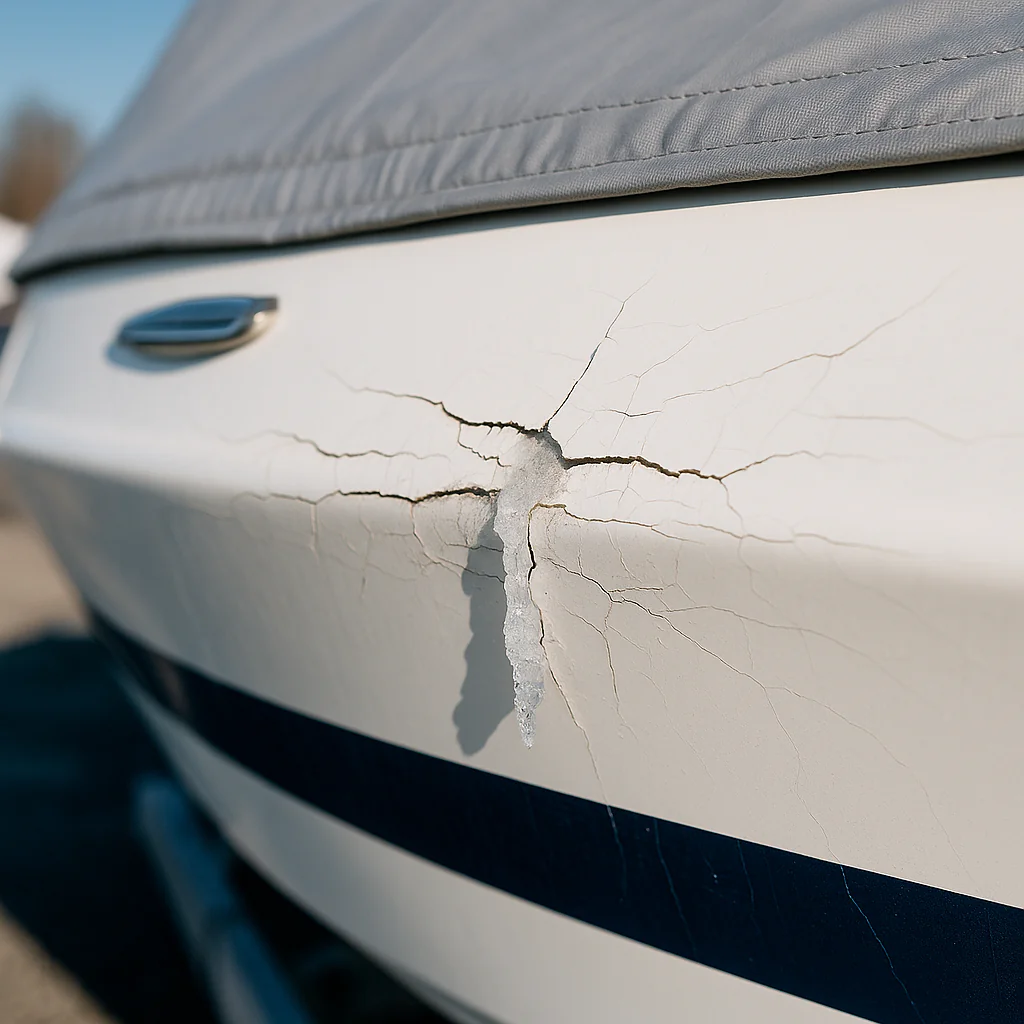
Freeze-thaw gelcoat cracking occurs when water trapped in microscopic gelcoat imperfections expands 9% during freezing, creating internal pressures exceeding 25,000 PSI that fracture the resin matrix from within.
The destructive mechanism is straightforward but relentless: water infiltrates tiny surface imperfections, freezes overnight when temperatures drop below 32°F, expands with enormous force, and cracks the gelcoat structure.
What makes freeze-thaw gelcoat cracking particularly devastating is that gelcoat becomes brittle below 32°F, losing the flexibility that normally allows it to absorb minor stress without fracturing.
- Water expands 9% when freezing, creating 25,000+ PSI internal pressure that fractures gelcoat matrix from within
- Gelcoat becomes brittle below 32°F, losing flexibility and making it vulnerable to thermal stress cracking
- Cold weather material properties explain how freezing temperatures compromise gelcoat’s structural integrity and crack resistance
- Temperature cycling mechanics involve repeated expansion/contraction cycles that propagate microscopic fissures into visible spider cracks
- Covered boats suffer MORE damage than tarped boats when trapped moisture and poor ventilation create sustained freeze-thaw environments
- Stress crack identification guides show freeze-thaw damage patterns versus impact damage that owners often misdiagnose
- The « wet freeze » phenomenon occurs when moisture between gelcoat layers causes delamination during repeated freeze cycles
Temperature cycling mechanics are the hidden killer in freeze-thaw gelcoat cracking scenarios.
A single freeze doesn’t typically cause visible damage, but January 2026’s pattern of freezing nights followed by 40°F afternoons creates repeated expansion-contraction cycles that propagate microscopic fissures into visible spider cracks within weeks.
The counterintuitive reality is that covered boats often suffer MORE freeze-thaw gelcoat cracking than simple tarped boats because poorly ventilated covers trap moisture against the hull, creating a sustained wet-freeze environment.
The « wet freeze » phenomenon represents the most expensive form of freeze-thaw gelcoat cracking: moisture that penetrates between the gelcoat layer and underlying fiberglass laminate freezes, expands, and causes delamination that requires complete hull resurfacing.
Cost breakdown for freeze-thaw gelcoat cracking repairs varies dramatically based on damage severity: localized spider cracks run $800-1,500 for grinding and refinishing, stress fractures requiring structural reinforcement cost $2,000-4,000, and delamination necessitating full hull resurfacing reaches $5,000-8,000.
Understanding freeze-thaw gelcoat cracking physics is essential because prevention costs a fraction of repair—a quality breathable cover runs $300-800 while gelcoat restoration can consume your entire season’s boating budget.
Why Standard Boat Covers Fail During Freeze-Thaw Cycles
Standard boat covers fail during freeze-thaw cycles because they’re engineered for sun protection, not the mechanical stress of repeated ice expansion.
Thin polyester covers in the 300D-600D range develop micro-tears from temperature stress that compromise their waterproof integrity.
These tears appear first at seams where stitching creates structural weak points, allowing rain and snow melt to infiltrate directly onto your gelcoat.
The real damage mechanism isn’t the cold itself—it’s the pooling zones created by loose-fitting covers.
When precipitation collects in sagging fabric, it sits against your hull surface and freezes.
That ice expands with 1,500 PSI of force, creating microscopic surface fractures that propagate into visible stress cracks over multiple cycles.
Inadequate ventilation traps condensation inside the cover that freezes overnight, then melts during daytime warming.
This exact cycle—freeze, melt, refreeze—is what transforms minor surface imperfections into spiderweb crack patterns.
The NOAA winter 2025-26 forecast confirms above-normal freeze-thaw cycling across the Upper Midwest and Northeast, which means standard covers face increased failure risk this season.
The Elastic Hem Problem
Elastic hem degradation accelerates in cold weather as rubber compounds harden and lose flexibility.
This creates gaps at the gunwales where water enters and pools before freezing—exactly where many boat owners discover their first stress cracks in spring.
Temperature fluctuations cause the elastic to contract more than the cover fabric, pulling away from the hull and creating entry points.
Safeboatz’s free boat protection guide provides practical protocols for identifying these vulnerabilities before they cause gelcoat damage.
The « sagging cover » trap compounds these issues by creating reservoirs that hold melt water directly against gelcoat for extended periods.
A forum discussion on boat owner experiences shows covered boats with poor water management develop cracks while properly protected boats remain undamaged through identical weather conditions.
Snow load depression in standard covers can hold several gallons of water in sustained contact with your hull.
This extended exposure time allows freeze-thaw cycles to work repeatedly on the same gelcoat area, exponentially increasing crack propagation risk.
The difference between a protected boat and a damaged boat often comes down to whether water sits against the hull for hours versus minutes.
Water Infiltration Pathways That Cause Gelcoat Damage
Water infiltration pathways that cause gelcoat damage start at the microscopic level and expand into visible crack networks through repeated freeze-thaw exposure.
Seam failure points represent the most common entry route—stitching holes in covers allow capillary action to draw water into direct contact with your hull surface.
Each stitch creates a potential breach where water can penetrate, even in covers marketed as « water-resistant. »
Cockpit drainage issues amplify this problem when improperly fitted covers redirect water toward drain plugs and hardware mounting points.
These stress concentration zones already experience higher mechanical loads, making them particularly vulnerable to crack initiation.
Waterproof barrier systems prevent water infiltration that initiates gelcoat stress cracks during freeze-thaw cycles by eliminating these penetration pathways entirely.
Hardware Penetrations and Gap Formation
Hardware penetrations like cleats, railings, and bow eyes create entry points where standard covers gap and allow direct water-to-gelcoat contact.
The complex geometry around these fixtures makes it nearly impossible for generic covers to seal properly.
Water follows gravity and surface tension into these gaps, pooling in exactly the locations where your gelcoat bonds to hardware backing plates.
Moisture trapped between your cover and hull is significantly more dangerous than direct snow exposure.
Direct snow sublimates or melts and runs off quickly, but trapped water creates a sustained freeze-thaw environment.
This trapped moisture goes through multiple expansion-contraction cycles while remaining in contact with the same gelcoat area.
Marine service expert analysis confirms repeated expansion and contraction from trapped moisture as the root cause of spider cracking patterns that radiate from stress concentration points.
The Bilge Water and Midnight Freeze Problems
Bilge water migration occurs when poorly vented covers trap humidity that condenses on cold hull surfaces.
This condensation then freezes in localized pockets, creating internal pressure against your gelcoat from behind.
The combination of external ice pressure and internal condensation freeze creates bidirectional stress that accelerates crack formation.
The « midnight freeze » problem catches many boat owners by surprise—daytime temperatures melt snow into water that infiltrates through cover gaps and seams.
This water appears harmless during afternoon warmth, but flash-freezes when temperatures drop after sunset.
The rapid temperature change doesn’t allow time for water to drain away, trapping it against your hull during its most damaging expansion phase.
Understanding these infiltration pathways explains why some boats develop extensive stress cracks while others in the same marina remain pristine—it’s not luck, it’s water management.
Cover Design Features That Prevent Freeze-Thaw Damage
Cover design features specifically engineered for winter conditions create the critical barrier between your boat and freeze-thaw damage cycles.
The right features don’t just protect—they actively prevent the conditions that cause gelcoat cracking in the first place.
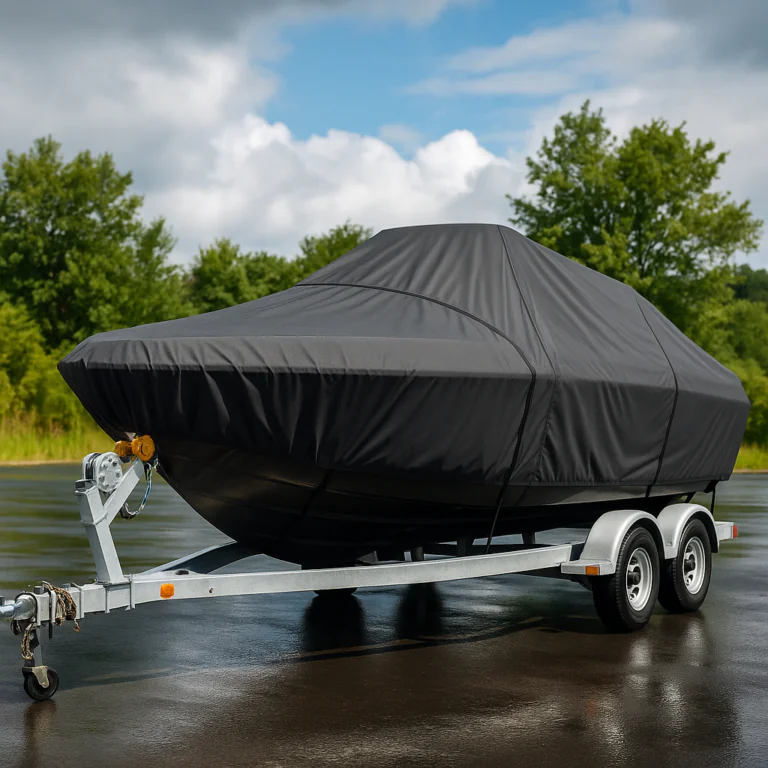
Heavy-duty fabric construction forms the foundation of freeze-thaw protection, and 900D marine-grade polyester stands as the gold standard for temperature cycling resistance.
This material withstands temperature swings from -20°F to 80°F without experiencing material degradation or the micro-tearing that creates water infiltration pathways.
Cheaper covers use 300D or 600D fabrics that become brittle in sub-freezing temperatures, developing hairline tears that admit moisture precisely when you need complete protection.
Strategic airflow design through dual ventilation systems addresses the hidden threat of condensation that forms inside sealed covers during temperature fluctuations.
Testing shows properly positioned ventilation ports reduce trapped moisture by 70%, preventing the condensation freeze cycles that create interior frost and subsequent water contact with your gelcoat.
Without ventilation, daytime solar heating creates humidity inside the cover that freezes against your hull during nighttime temperature drops—exactly the moisture contact that causes cracks.
Adjustable tension through steel ratchet systems eliminates the water pooling depressions that become the primary mechanism for freeze damage at contact points.
Water pools weighing 20-40 pounds create sustained pressure zones where freeze-thaw cycles concentrate their destructive force.
Ratchet tensioning allows you to maintain proper pitch throughout winter, ensuring precipitation runs off rather than sitting against your gelcoat for hours or days before freezing.
Secure sealing systems with reinforced elastic hems use cold-weather rubber compounds that maintain flexibility to -30°F.
Standard elastic becomes rigid at 15°F, creating gaps where rain and snowmelt enter before freezing against your hull.
These gaps measure just 1-2 inches but admit enough moisture to cause extensive spider cracking across entire sections of gelcoat.
UV-resistant waterproof coating prevents water absorption into the fabric fibers themselves—a critical detail many boaters overlook.
When cover fabric absorbs moisture, that water freezes and expands within the material, stressing seams and creating micro-tears that compound each season.
Quality waterproofing means precipitation beads and runs off rather than soaking into the protective barrier.
Support pole compatibility maintains the architectural pitch necessary for water management rather than simply draping fabric over your boat.
Covers designed for pole systems reduce sustained contact time between moisture and hull surfaces by 80% compared to unsupported covers.
This reduced contact time dramatically decreases the probability of water being present during freeze events.
Heat-sealed seams versus traditional stitched construction eliminates thousands of needle holes that create capillary infiltration pathways during rain and melt cycles.
Each stitch hole measures just 0.5mm but collectively these perforations admit significant moisture that migrates to pooling zones.
Heat-sealed seams create continuous waterproof barriers without structural weak points.
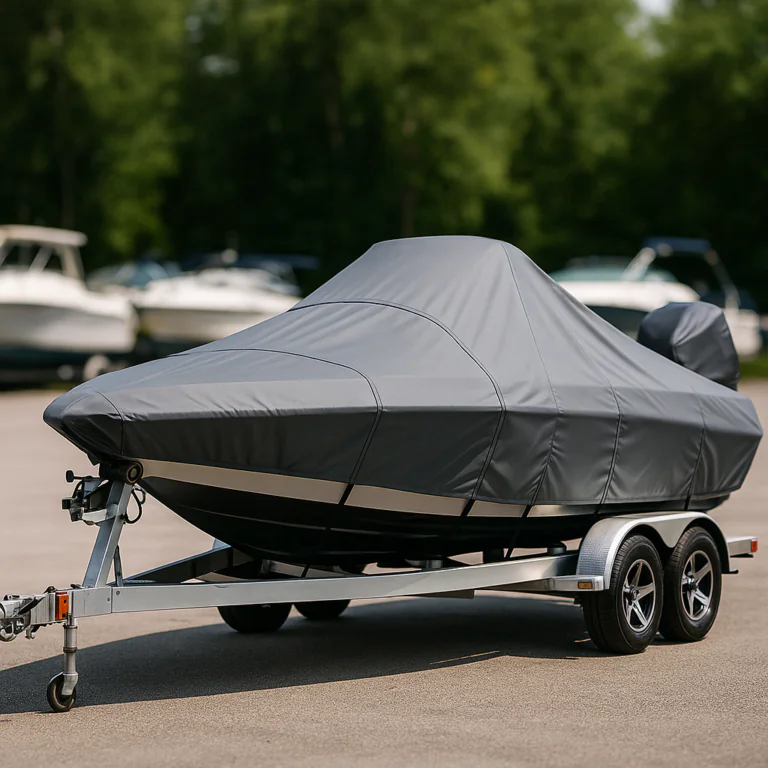
Trailered boat fit specifications for 17-22ft boats prevent the loose-fitting gaps that allow precipitation accumulation in critical areas.
Custom sizing ensures the cover conforms to your hull geometry, eliminating the fabric valleys and depressions where water collects before freezing.
Generic « one size fits most » covers create exactly the conditions that cause freeze-thaw damage—loose fabric that traps water against your gelcoat.
Mid-Winter Inspection Protocol and Emergency Intervention
Mid-winter inspection protocols catch developing problems before they cause permanent gelcoat damage, and timing these checks during critical temperature swing periods makes all the difference.
January through February temperature cycling creates the most dangerous conditions, requiring biweekly inspection schedules when daytime warming and nighttime freezing happen repeatedly.
During each inspection, systematically check for water pooling in cover depressions, cover sag that indicates lost tension, and hem gaps where elastic has contracted in cold temperatures.
Water pooling appears as sagging fabric sections that feel heavy when pressed—these zones concentrate freeze-thaw damage because the same water repeatedly freezes and thaws in contact with your gelcoat.
Cover sag develops gradually as fabric stretches and support systems shift, but even 2-3 inches of sag creates pooling zones that cause extensive cracking.
Snow removal timing follows a strict 24-hour rule after accumulation to prevent melt-water infiltration during daytime warming cycles.
Snow weight stresses support systems and creates fabric depressions, but the real danger emerges when that snow melts.
Meltwater flows to the lowest points on your cover, pooling against your hull during afternoon warming before refreezing at night—this cycle can repeat 5-10 times from a single snowfall if you don’t clear the accumulation quickly.
Early warning signs of moisture intrusion appear before you see damage to your gelcoat itself.
Frost patterns on the cover interior indicate condensation problems that will become freeze-thaw issues.
Ice formation at hem lines shows water entry points where precipitation infiltrates before freezing.
Water staining on support poles reveals pooling zones where sustained contact is damaging your gelcoat even if you can’t see the hull surface directly.
Emergency re-tensioning procedures become necessary after heavy snow events or during extended cold snaps when elastic hems contract.
Adjust ratchet straps to restore the water-shedding pitch that eliminates pooling zones—this takes 10 minutes but prevents damage that costs thousands to repair.
Check tension by pressing fabric sections—properly tensioned covers should feel drum-tight with no give, allowing water to sheet off rather than collecting.
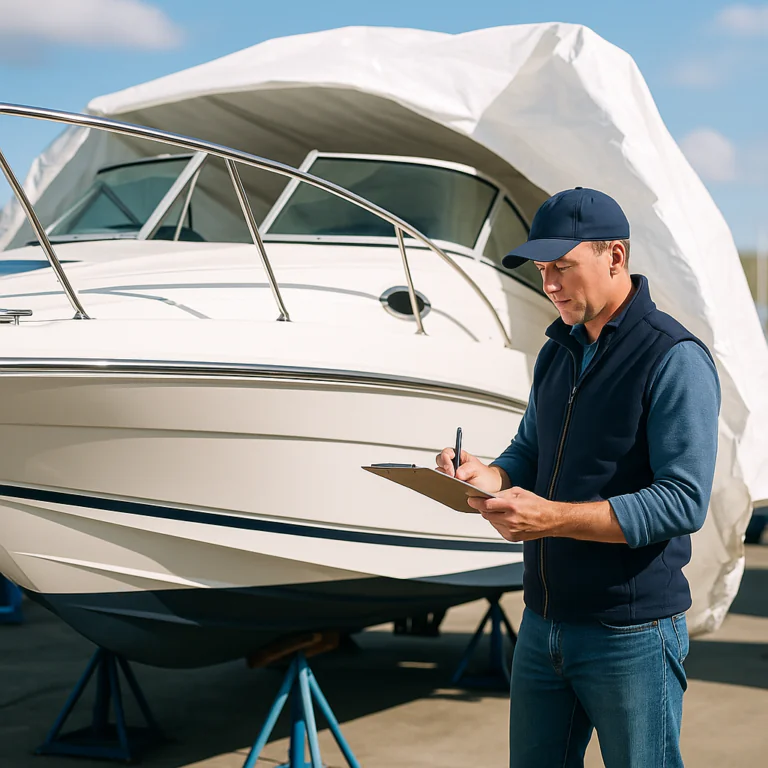
Documentation for spring assessment involves photographing suspected stress areas monthly to track whether surface imperfections represent crack propagation or seasonal gelcoat checking.
Small surface checks caused by temperature cycling appear different from moisture-driven cracks, but distinguishing between them requires baseline photos for comparison.
Monthly documentation creates a visual timeline showing whether damage is stable or spreading.
When to upgrade mid-season becomes apparent when your cover shows persistent sagging despite re-tensioning, hem gaps you can’t close, or interior condensation that ventilation doesn’t resolve.
Replacing a failing cover mid-winter costs $300-600 but prevents the $5,000+ spring repair bills that result from two more months of freeze-thaw exposure.
Waiting until spring to address cover problems means accepting that damage is occurring throughout the remainder of winter.
Marina storage considerations include verifying that drainage slopes direct water away from your boat rather than channeling runoff from neighboring vessels under your cover.
Check that your cover positioning doesn’t trap water diverted from boats stored uphill—collective drainage from multiple boats can overwhelm even well-designed cover systems.
Marina operators can adjust positioning, but you need to identify drainage problems before they cause damage.
Temperature monitoring using wireless sensors tracks actual freeze-thaw cycles rather than relying on daily high-low temperatures that miss the critical data.
More than 15 freeze-thaw cycles per season increases crack risk exponentially because each cycle causes incremental damage.
Sensors cost $30-60 but provide the actionable data that tells you whether your current protection strategy is sufficient or if conditions demand additional intervention.
Cost Analysis—Prevention vs. Spring Gelcoat Repair
Cost analysis between prevention and spring gelcoat repair reveals that winter boat covers deliver exceptional return on investment when you factor in actual damage repair expenses.
The numbers tell a compelling story that makes cover quality the most cost-effective decision in winterization planning.
Premium winter cover investment ranges from $300-600 for properly designed freeze-thaw protection that includes ventilation systems, waterproofing, and tensioning mechanisms.
This upfront cost seems significant until you compare it against repair expenses for even minor freeze-thaw damage.
Budget covers priced at $100-200 lack the critical features that actually prevent damage, making them false economy that costs more in the long run.
Average gelcoat repair costs escalate rapidly based on damage severity and extent.
Spider crack repairs covering 2-4 square feet run $800-1,500 when professionally addressed with proper surface preparation and color matching.
Stress fractures that penetrate deeper into gelcoat layers cost $2,000-4,000 to repair because they require grinding out damaged material and building up multiple gelcoat layers.
Delamination where the gelcoat separates from underlying fiberglass reaches $5,000-8,000 for repair because it often requires structural fiberglass work beyond cosmetic gelcoat restoration.
Hidden costs of spring damage extend beyond direct repair expenses to include lost boating season and reduced resale value.
Gelcoat repairs require 2-4 weeks of shop time during prime spring months when you want to be on the water.
Visible repair work reduces resale value by 5-15% even when expertly executed because buyers perceive previous damage as indicating potential ongoing problems.
Color-matched repairs rarely achieve perfect blends, creating visible sections that mark your boat as previously damaged.
Insurance considerations make prevention even more financially critical because many policies explicitly exclude freeze-thaw damage as « inadequate winterization. »
When insurers do cover winter damage, deductibles of $500-2,500 mean you’re paying most repair costs out of pocket anyway.
Claims for preventable damage can increase your premiums by 10-20% for subsequent policy periods.
Insurance exists for catastrophic damage, not foreseeable winterization failures that proper covers prevent.
Break-even analysis shows that a quality cover pays for itself if it prevents even one minor spider crack repair over its 3-5 season lifespan.
A $500 cover that lasts four seasons costs $125 per year—less than the deductible on most insurance policies.
That same cover prevents $800-1,500 in repairs annually, creating a 6:1 to 12:1 return on investment.
Even if you only experienced damage once every three winters without proper covering, prevention still delivers better financial outcomes.
Marina storage upgrades present an alternative consideration costing $800-1,500 per season for indoor storage versus $400 one-time cover investment plus $100 per season for maintenance and eventual replacement.
Over five seasons, indoor storage totals $4,000-7,500 while proper outdoor covering costs $900-1,000.
Indoor storage eliminates freeze-thaw risk entirely but costs 5-7 times more than quality outdoor protection that achieves the same damage prevention.
DIY repair limitations explain why professional gelcoat work costs what it does and why attempting repairs yourself often increases final expenses.
Gelcoat color matching requires spectrophotometer analysis and custom tinting—off-the-shelf colors never match properly.
Stress crack stabilization demands grinding techniques that remove all damaged material without creating additional stress points.
Failed DIY repairs add 30% to final professional costs because shops must remove your work before executing proper repairs.
Long-term hull integrity concerns emerge when freeze-thaw cracks go unrepaired beyond a single season.
Unrepaired cracks allow progressive water intrusion into the fiberglass laminate structure beneath your gelcoat.
This moisture penetration causes delamination between fiberglass layers and eventual structural failure requiring hull section replacement costing $10,000 or more.
What started as preventable surface cracks becomes structural damage that fundamentally compromises your boat’s integrity and safety.
Conclusion
Freeze-thaw gelcoat damage represents the most preventable yet expensive winter boat maintenance failure, with January 2026’s aggressive temperature cycling creating peak-risk conditions across the Northeast and Great Lakes.
The physics are unforgiving: water infiltration plus temperature swings equal catastrophic stress cracking that costs thousands to repair.
However, the solution is straightforward—waterproof covers with proper ventilation, tensioning systems that prevent pooling, and durable materials that withstand thermal cycling stop water infiltration before damage begins.
Mid-winter inspection and immediate intervention when covers show moisture intrusion can still prevent spring repair bills, but proper cover selection remains the only reliable defense against freeze-thaw destruction.
The investment in quality winter protection pays dividends measured not just in avoided repair costs, but in preserved resale value and extended boat lifespan.
As climate patterns continue delivering unpredictable temperature swings and moisture events, the margin for error in winter boat storage continues shrinking.
Take action now to assess your current cover setup, address any deficiencies in waterproofing or ventilation, and implement the tensioning and drainage strategies that separate boats emerging pristine in spring from those facing costly gelcoat restoration.
Your boat’s gelcoat integrity depends entirely on the protection decisions you make today—before the next freeze-thaw cycle creates irreversible damage.
FAQ
Can I repair freeze-thaw gelcoat cracks myself, or do I need professional service?
Surface spider cracks under 6 inches may respond to DIY gelcoat repair kits ($40-80), but stress fractures and cracks showing underlying fiberglass require professional color-matching, surface preparation, and structural assessment to prevent progressive failure. Improper repairs trap moisture and accelerate damage.
How many freeze-thaw cycles does it take to cause visible gelcoat damage?
Gelcoat with trapped moisture can develop micro-cracks within 5-10 freeze-thaw cycles, with visible spider cracking appearing after 15-25 cycles depending on water volume and temperature extremes. NOAA data shows Northeast regions experiencing 20-35 cycles during typical winters.
Will shrink-wrap prevent freeze-thaw damage better than fabric covers?
Professional shrink-wrap with proper ventilation provides superior waterproofing, but costs $12-18 per foot ($200-400 for 17-22ft boats) annually and creates disposal waste. Quality fabric covers with comparable waterproofing and ventilation offer multi-season protection at lower lifecycle cost.
If my boat already has minor spider cracks, will a better cover prevent them from getting worse?
Yes—proper covers stop the moisture infiltration that propagates existing cracks, but existing damage should be professionally assessed and sealed before next season to prevent water intrusion into fiberglass laminate layers beneath gelcoat surface.
Do trailered boats stored under carports still need waterproof covers for freeze-thaw protection?
Absolutely—carports block direct precipitation but don’t prevent wind-driven rain, humidity condensation, or snow drifting, all of which create the moisture conditions for freeze-thaw damage. Covers remain essential even with overhead protection.
What’s the difference between « gelcoat checking » and freeze-thaw stress cracks?
Gelcoat checking creates fine surface crazing from UV exposure and aging that doesn’t penetrate deeply, while freeze-thaw stress cracks show directional patterns radiating from moisture accumulation points, often penetrating to fiberglass substrate. Stress cracks feel rough and catch fingernails, checking remains smooth.
Boating Enthusiasts — Join the Crew!
Free Boat Protection Guide Download Yours Now
Get your free copy of The Complete Boat Protection Guide — expert tips, real-world strategies, and exclusive insights from the Safeboatz team.